
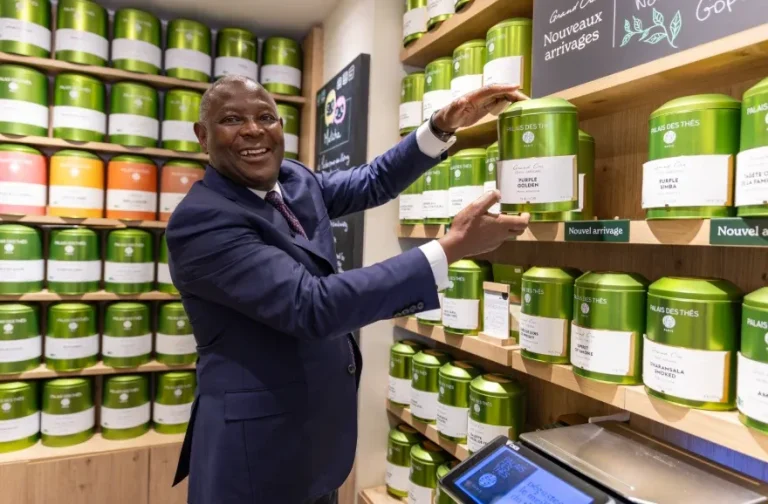

Kenya’s Purple Tea has made its debut in Paris, this follows an agreement signed during the Africa Forward Summit involving Gatanga Industries, Palais des Thés and Equity Group. This was with an aim to expand market access for Kenyan specialty tea and connect producers directly with premium global consumers.
The move marking a significant step in the country’s efforts to reposition its tea industry. This is from a volume-driven commodity business to a premium agricultural export built on origin, quality and value addition.
The unveiling took place at the Hôtel de Crillon in Paris, where French consumers, tea specialists and industry stakeholders were introduced to one of Kenya’s most distinctive specialty teas. Known for its deep colour, floral aromas, subtle fruit notes and high antioxidant content, Purple Tea is increasingly attracting interest in international specialty markets.

Grown primarily in Murang’a County on the fertile volcanic soils of Kenya’s central highlands, Purple Tea represents a new growth opportunity for the country’s tea sector. Unlike traditional black tea exports that often compete on price, specialty teas allow producers to earn higher returns through branding, traceability and product differentiation.
The Paris launch also demonstrated the potential of Kenyan tea beyond traditional beverage markets. During the recent G7 Summit in Évian, chefs from the Élysée Palace developed a dark chocolate infused with Kenyan Grand Cru tea selected by French tea company Palais des Thés. This collaboration proved that Kenyan agricultural products can be embedded in premium consumer products creating new opportunities for value addition.
Equity Group Managing Director and CEO Dr. James Mwangi said the country must build a distinct identity around its specialty teas in order to unlock greater value for farmers.
“Kenyan tea needs a distinct sub-identity and strong geographical identity. What we are witnessing is the beginning of a journey to transform tea from a commodity into a premium product,” he said.
According to Dr.Mwangi, moving from commodity pricing to premium positioning has the potential to improve farmer incomes while creating broader economic benefits for rural communities.
He noted that increased earnings could support household investments in education, healthcare and long-term economic development. This is while changing how Kenya approaches agricultural production and exports.
Palais des Thés founder and chairman François-Xavier Delmas said the Paris unveiling represents the beginning of a broader effort to increase the visibility of Kenyan specialty tea across France and Europe.
He emphasized the importance of geographical indications in helping consumers understand the origin and unique qualities of agricultural products, adding that such recognition can help build stronger premium brands in international markets.Kenya’s Ambassador to France, Betty Chebet Cherwon, said the initiative reflects the growing trade relationship between the two countries and demonstrates the importance of value addition in strengthening Kenya’s export earnings.
She noted that moving beyond raw commodity exports allows Kenyan products to capture greater value in international markets while creating new opportunities for producers and strengthening economic ties between Kenya and France.
Equity Group Holdings Non-Executive Chairman Prof. Isaac Macharia said the initiative demonstrates the impact that partnerships between farmers, financial institutions and international buyers can have in expanding market opportunities.
He said positioning Kenyan specialty tea in premium global markets not only increases the value of agricultural products but also creates sustainable economic opportunities for farming communities.
The Paris debut comes as Kenya advances efforts to secure Geographical Indication (GI) status for Purple Tea. GI protection links products to specific places of origin and provides legal recognition of qualities associated with those regions. Such certification can help producers differentiate their products in the market and support premium pricing, while consumers benefit from assurance regarding authenticity, origin and quality.
The growing interest in Purple Tea also reflects wider changes in global consumer preferences. Increasingly, specialty food and beverage buyers are looking for products with clear origins, transparent supply chains and authentic stories about the communities that produce them.
As Kenya looks to diversify its agricultural exports and increase value addition, Purple Tea is emerging as a product that could help redefine the country’s position in the global tea market. As well as creating new opportunities for farmers beyond traditional commodity trade.