

Equity Group has reported a 32% increase in profit after tax to KSh 71.5 billion for the nine months ended September 30, 2026. This was up from KSh 54.1 billion recorded during a similar period last year.
Profit before tax rose by 37% to KSh 89.8 billion from KSh 65.6 billion, supported by growth in lending, increased non-funded income and stronger contributions from the Group’s regional subsidiaries.
The Group’s total income increased by 23% to KSh 192 billion, compared to KSh 156.2 billion in the third quarter of 2025. Net interest income grew by 15% to KSh 107.7 billion, while non-funded income rose by 34% to KSh 84.3 billion from KSh 62.7 billion.

Non-funded income accounted for 44% of total income, up from 40.1% a year earlier, reflecting increased contributions from the Group’s diversified financial services businesses.
The Group’s balance sheet also expanded, with total assets growing by 18% to KSh 2.15 trillion from KSh 1.82 trillion. Customer deposits increased by 19% to KSh 1.58 trillion, while net loans rose by 17% to KSh 1.01 trillion from KSh 859.8 billion.
Shareholders’ funds increased by 22% to KSh 369.7 billion, strengthening the Group’s capital position.
Regional subsidiaries drive earnings growth
Equity Group’s regional businesses continued to contribute significantly to its overall performance, accounting for 42% of banking profitability, 50% of banking revenue and 54% of deposits.
Equity Bank Kenya recorded a 31% increase in profit after tax to KSh 40.7 billion from KSh 31.1 billion in the corresponding period last year. The performance was supported by 10% growth in customer deposits and 12% growth in loans, alongside a 7% increase in assets.
The bank also maintained its position in MSME financing, disbursing 34% of the KSh 245 billion in MSME loans issued in Kenya between January and June 2026.
Among the regional subsidiaries, Equity Bank Tanzania recorded the highest profit growth at 60%, with profit after tax reaching KSh 2.4 billion. Equity Bank DRC posted a 34% increase to KSh 18.5 billion, while Equity Rwanda recorded 10% growth to KSh 4.4 billion.
The Group’s insurance business also recorded strong growth. Gross written premiums increased by 52% to KSh 10 billion, while profit before tax rose by 34% to KSh 1.96 billion.
Asset quality and operational efficiency improve
Equity Group continued to strengthen its asset quality, with the non-performing loan (NPL) ratio declining to 9.3% from 12.1% a year earlier.
The cost of risk improved to 1.5% from 1.9%, while NPL coverage remained at 71%, reflecting improved credit management and risk controls.
Operational efficiency also improved, with the cost-to-income ratio declining to 47.9% from 50.6%. Return on average assets stood at 4.6%, while return on average equity reached 27.2%.
The Group attributed the improvement in efficiency to productivity gains, shared services and increased customer adoption of digital banking channels.
Digital banking accounts for 89.5% of transactions
Equity Group continued to record increased adoption of its digital banking platforms, with 98.3% of customer transactions conducted outside physical branches and 89.5% processed through digital channels.
The Group serves more than 24 million customers through its digital platforms, including Equity Online, the Equity Mobile App, Eazzy FX, *247# and Equitel.
Its physical distribution network comprises 411 branches, 883 ATMs, 95,510 agency outlets and 1.4 million merchants.
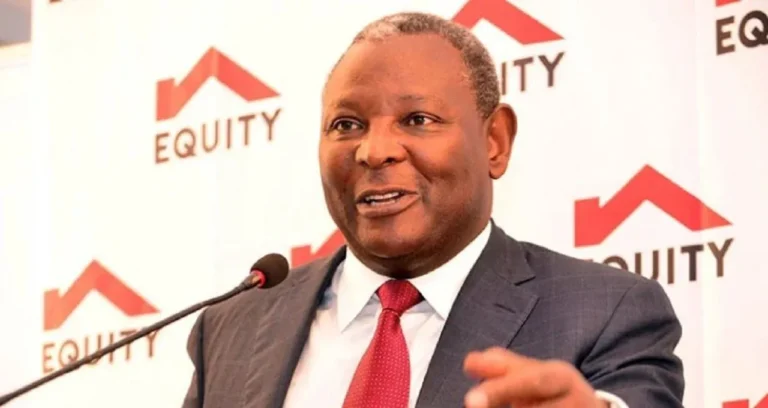
Equity Group Managing Director and Chief Executive Officer Dr James Mwangi said the performance reflected the impact of the Group’s transformation strategy and growing regional presence.
He noted that the Group’s diversified operations across different markets and business segments had strengthened its resilience amid global economic uncertainty and inflationary pressures.
Mwangi added that continued investment in digital and artificial intelligence capabilities would support customer service, productivity and the Group’s expansion across African markets.
The Group has also stepped up investment in employee development, with staff completing 163,860 hours of guided AI instruction. Additionally, 714 employees have been admitted to master’s programs in Financial Engineering at WorldQuant University, while another 1,948 have enrolled in its Strategic AI and Innovation programme.
Expanding financial inclusion
Beyond its banking operations, Equity Group continued to expand its financial inclusion, education, healthcare and environmental programmes through the Equity Group Foundation.
Under its education and leadership development programmes, the Foundation currently supports more than 11,663 high school scholars. Its Wings to Fly and Elimu scholarship programmes have benefited 60,009 students to date.
The Foundation has also trained more than one million entrepreneurs and facilitated over KSh 457.1 billion in credit access to micro, small and medium-sized enterprises.
In agriculture, the Foundation is implementing the USD 25 million SASTAIN programme in partnership with the Mastercard Foundation. The initiative targets 60,000 smallholder farmers and agricultural MSMEs in Tanzania and the Democratic Republic of Congo.
Its environmental programmes have supported the planting of more than 50.2 million trees, alongside investments in clean energy, water and sanitation.
Equity Group also secured accreditation as a Direct Access Entity to the Green Climate Fund, enabling it to directly mobilise international climate financing for projects focused on climate adaptation, mitigation and sustainable development.
In healthcare, Equity Afya expanded its network to 159 medical centres, which have recorded more than 5.7 million patient visits. The business also opened its first two community pharmacy outlets as part of plans to establish a network of 1,000 pharmacies across the region.
Looking ahead, Equity Group remains focused on implementing its Africa Recovery and Resilience Plan 2030. It is targeting expansion into 15 countries, serving 100 million customers and deploying digital and AI-enabled financial services to support economic transformation across Africa.