
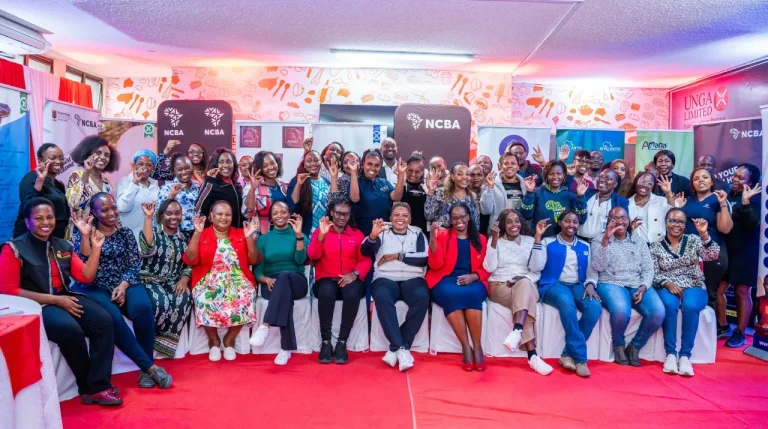

NCBA Bank has launched the second cohort of the Affirmative Finance Action for Women in Africa (AFAWA) Acceleration Program. The new cohort brings on board 42 women agripreneurs as the bank deepens its support for women-owned small and medium enterprises in Kenya.
The program is the product of a partnership with the African Guarantee Fund (AGF) and Unga Group Plc. It is designed to improve access to financing, business training, and market opportunities for women-led businesses operating across the agricultural value chain.
The latest intake builds on the first cohort, where 38 women entrepreneurs received a combined USD 1.5 million in funding alongside training and mentorship support to help strengthen and grow their businesses. The latest intake will be financed with an amount of Ksh. 455 million.

Backing women entrepreneurs
In Kenya’s SME sector, women often carry the dual role of income earners and household managers, making their businesses central to family stability, education, and long-term financial security.
For women in agriculture, the stakes are even higher. Their businesses sit within sectors directly linked to food supply, livestock, and household nutrition. By targeting women in human food production and animal feed, the program places capital and business support in the hands of entrepreneurs already playing an active role in strengthening local supply chains.
NCBA Group Director for Retail Banking Dennis Njau said the bank is focused on addressing barriers that continue to limit women entrepreneurs.
“This programme aims to support women business owners across the agricultural value chain who often face additional structural constraints through an integrated approach comprising access to skills, markets and finance. This partnership is a clear demonstration of our Ubuntu philosophy in motion, anchored on enabling productivity by building solutions around what truly matters to our customers,” he said.
Addressing the financing gap
Access to capital remains one of the biggest challenges facing women entrepreneurs across Africa. Program partners estimate that women-led businesses face a USD 42 billion financing gap, driven largely by limited collateral, lower access to formal financial systems, and smaller average loan sizes.
To address this, the AFAWA programme uses a partial guarantee model between NCBA and AGF, allowing the bank to extend credit while reducing lending risk.
This approach is intended to make financing more accessible to SMEs that may be viable businesses but struggle to meet conventional lending requirements.
Patrick Lumumba, Group Director for Capacity Development at African Guarantee Fund, said the model is designed to open more lending opportunities for women-owned enterprises.
“Through our partnership with NCBA under the AFAWA framework, we are reducing the barriers that have historically limited women-owned SMEs from accessing credit. By de-risking lending, we are enabling financial institutions to extend more capital to women entrepreneurs, ultimately driving inclusive growth and job creation across key sectors of the economy,” he said.
NCBA support beyond financing
The program combines lending with technical training, mentorship, and market access support. This reflects a wider shift by banks toward offering SMEs a broader ecosystem instead of capital alone.
Under the partnership, Unga Group Plc acts as the learning partner, providing participants with industry exposure, technical expertise, and operational insights linked to the agri-food sector.
Unga Group Managing Director James Nyutu said women entrepreneurs supported under the programme are positioned to strengthen broader food systems.
“As a learning partner, Unga Group is committed to equipping these entrepreneurs with practical industry insights, technical expertise, and exposure to scalable business practices within the agri-food value chain. We believe that empowering women at this level strengthens not just individual businesses, but the entire ecosystem that supports food production and security in Kenya,” he said.
The programme is expected to support a total of 80 women-owned SMEs across the two cohorts and contribute to the creation of approximately 300 jobs.
Building businesses with long-term impact
For participating women, access to funding is only one part of the equation. Business training, operational support, and mentorship can often determine whether an SME remains small or grows into a stable employer.
That is particularly relevant for women entrepreneurs managing businesses while raising families, paying school fees, supporting dependents, and creating employment within their communities.
Linda Onyango, CEO of the SME Support Centre (SSC), said the second phase is focused on building sustainable businesses through integrated support.
“Following the success of the first cohort, we are excited to launch the second phase of this acceleration programme, which supports women owned enterprises through integrated access to skills, markets, and finance. By combining practical training, industry exposure through Unga Group, on site business support, and financial linkages with NCBA, we are enabling real, sustainable business growth,” she said.
As banks compete to strengthen their SME portfolios, NCBA is increasingly positioning itself as an active partner for women-owned businesses by combining financing with practical business support.