
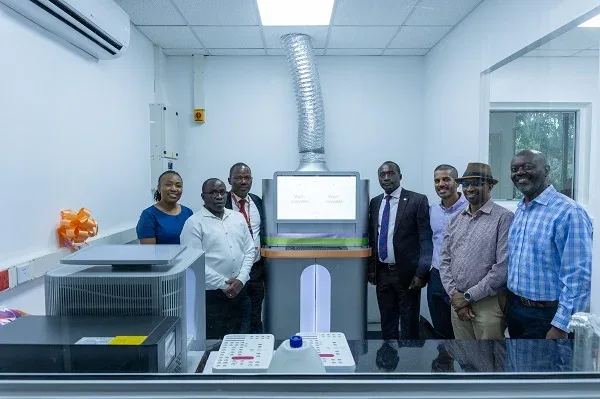

Building an advanced genomics laboratory in Kenya required more than scientific expertise for Dr George Ngondi. The bigger challenge was securing financing for equipment that costs millions of dollars and requires specialized infrastructure to operate. This was until Equity Bank came into the picture.
Ngondi, a microbiologist and genomics expert, is the founder and director of Nextgen Molecular Lab. The lab conducts molecular and genomic testing to help diagnose diseases and understand them through the analysis of genetic material.
To establish the laboratory’s high-throughput genetic sequencing capability, he needed approximately US$3.5 million, equivalent to about KSh454 million. Finding a lender willing to finance such a specialized investment proved difficult.

“We approached many banks, and everywhere we went, we faced a lot of challenges. So, we had to go for debt financing, and debt financing was a bigger challenge,” Ngondi said.
The breakthrough came when Equity Bank structured financing around the laboratory’s main piece of equipment, the NovaSeq™ System, an advanced genetic sequencing platform.
The KSh100 Million Investment
Before acquiring the sequencing system, Ngondi had already invested more than KSh100 million in laboratory equipment and supporting infrastructure.
The investment included a negative-pressure room for DNA isolation, polymerase chain reaction (PCR) machines, quality-control analyzers and equipment used in preparing genetic material for sequencing.
These facilities are essential to the work of an advanced genomics laboratory. The sequencing machine cannot operate in isolation; it depends on the appropriate equipment, controlled environments and processes to prepare and analyze biological samples.
The additional investment also meant Ngondi had committed substantial capital before securing the financing needed to acquire the main sequencing platform.
For a specialized laboratory, this creates a significant financial challenge. The equipment is expensive, and its value depends on the wider infrastructure required to support its use.
The NovaSeq System
At the centre of Nextgen Molecular Lab’s investment is the NovaSeq™ System, an ultra-high-throughput next-generation sequencing platform designed to process large volumes of genetic material.
To understand its role, consider a blood sample collected for laboratory analysis. The sample contains DNA carrying genetic information, but that information cannot be examined directly with the naked eye.
Genetic sequencing reads the DNA and generates data that scientists can analyze to identify variations in genetic material. Depending on the sample, testing method and research objective, these findings can help investigate genetic changes associated with disease, study pathogens and examine antimicrobial resistance.
The NovaSeq System allows laboratories to process substantial amounts of genetic material, making it useful for research and other applications that require high-throughput sequencing.
For Nextgen Molecular Lab, the investment provides the technological capacity to undertake advanced genomic analysis in Kenya.
Genomic Sequencing
Genomic sequencing is increasingly important in medical research because genetic information can provide insights into diseases and how they affect individuals.
Researchers can use sequencing data to investigate genetic variations, study how diseases develop and examine differences in how patients respond to certain medicines.
The technology also has applications in infectious disease research, including the study of pathogens and genetic changes associated with drug resistance.
These applications contribute to the development of precision medicine, an approach that uses biological information, including genetic data where appropriate, to help guide healthcare decisions.
However, sequencing results require expert interpretation and must be considered alongside other clinical information. The technology does not independently diagnose every disease or determine the appropriate treatment for every patient.
For laboratories, access to high-throughput sequencing equipment creates opportunities to support more extensive genomic research and investigations that require large volumes of data.
How Equity Structured the Financing
The cost of acquiring the NovaSeq System presented a major hurdle for Ngondi, despite the substantial investment already made in establishing the laboratory.
Traditional financing can be difficult to secure for specialized scientific equipment, particularly when the investment involves high upfront costs and assets that require technical expertise to value and operate.
Equity Bank’s approach was to structure the financing around the genetic sequencing equipment itself, providing a route towards acquiring the system.
This was significant because the machine was the central asset in the planned expansion of the laboratory’s capabilities. Financing structured around the equipment addressed a major part of the investment required to establish high-throughput sequencing capacity.
The case illustrates one of the challenges facing businesses in specialized sectors: access to capital can determine whether an investment in advanced technology moves from planning to implementation.
For entrepreneurs investing in scientific infrastructure, the availability of financing suited to the nature of the asset can be as important as identifying the technology itself.
Financing Advanced Technology
Ngondi’s experience highlights the capital requirements involved in building specialized scientific facilities in Kenya.
Beyond purchasing equipment, laboratories must invest in suitable premises, supporting machinery, quality-control systems and the technical capacity required to operate their facilities.
For businesses in fields such as biotechnology and genomics, these costs can make it difficult to secure funding through conventional channels.
The financing arrangement with Equity Bank helped address a key obstacle in Nextgen Molecular Lab’s acquisition of the NovaSeq System.
As demand grows for advanced laboratory testing and genomic research, access to suitable financing will remain an important consideration for businesses seeking to invest in specialized medical and scientific technology.