
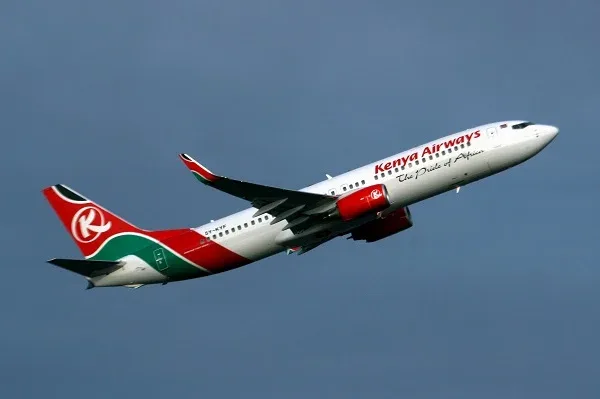

Kenya Airways net loss increased to KES 16.08 billion for half year 2026. This is as compared with KES 12.15 billion in a similar period last year.
The deterioration came despite growth in total income, which increased by 9.1% to KES 81.25 billion. The revenue growth was achieved despite a 9% reduction in capacity. This was due to stronger aircraft utilization, a four-percentage-point improvement in cabin factor supporting the airline’s commercial performance.
“We grew revenue by 9% to KShs 81 billion despite operating with 9% less capacity. The improvement in our cabin factor and the strength of average coupon values demonstrate that demand for our network remains resilient,” said Dr. George Kamal, Ag. Group Managing Director and Chief Executive Officer.

Operating costs, however, rose by 13.8% to KES 91.90 billion, significantly faster than revenue.
Costs outpace revenue
The increase in operating costs remains one of the key challenges facing the airline. Kenya Airways added about KES 6.77 billion to revenue compared with the first half of 2025, but operating costs increased by approximately KES 11.08 billion.
One of the factors behind the higher costs was a sharp increase in jet fuel prices during the period driven by geopolitical tensions in the Middle East. Kenya Airways said its fuel costs increased by 32% compared with the same period last year. Fuel accounted for about 32% of total operating expenses and 52% of direct operating costs.
The airline also faced global supply-chain constraints, including shortages of critical spare parts, longer lead times and delays in component availability. These challenges affected aircraft availability and operational reliability.
The impact was reflected in the operating loss, which widened from KES 6.24 billion to KES 10.64 billion. Other costs, however, declined by 10.7% to KES 5.33 billion, providing some relief during the period.
Balance sheet weakens
The pressure on the airline’s earnings was accompanied by a deterioration in its balance sheet. Kenya Airways’ total assets declined by 1.6% to KES 180.30 billion during the first half of 2026. Non-current assets fell by 3.9% to KES 136.32 billion, while current assets increased by 6.2% to KES 43.97 billion.
At the same time, the airline’s total liabilities increased by 4.1% to KES 328.16 billion. Non-current liabilities rose by 2.8% to KES 187.54 billion, while current liabilities increased by 5.8% to KES 140.61 billion. The result is a further widening of Kenya Airways’ negative equity position.
The airline reported negative equity of KES 147.86 billion, compared with KES 132.07 billion at the end of December 2025. This represents a deterioration of KES 15.79 billion in the first six months of the year.
Lower capacity
Kenya Airways operated with 9% lower capacity during the first half of 2026. This was as aircraft availability and maintenance challenges affected its operations.
The airline’s capacity decline came despite resilient demand. It had a four-percentage-point improvement in cabin factor indicating that available capacity was being utilized more effectively.
There is also some indication that capacity pressures could ease in the second half of the year. A Boeing 787-8 returned to service in mid-July, while a Boeing 777-300ER has also been redelivered and returned to Kenya Airways’ operations.
The return of the aircraft is expected to strengthen network resilience, improve operational flexibility and allow the airline to respond to additional demand.
Financial pressure
The combination of wider losses, higher liabilities and a larger negative equity position leaves Kenya Airways facing continued financial pressure.
While current assets increased during the period, they remained significantly below current liabilities. The airline ended the first half with KES 43.97 billion in current assets against KES 140.61 billion in current liabilities.
The figures highlight the scale of the financial challenge as Kenya Airways works to improve its operating performance. The airline has identified cost reduction, cash conservation, restoring fleet capacity, improving aircraft utilization. As well as completing its planned capital raising as key priorities in strengthening its financial position.
Kenya Airways Chairman Kiprono Kittony said the airline remains focused on building a more stable platform for long-term growth.
“Our focus now is firmly on recovery and building a stronger Kenya Airways. We will continue to manage costs rigorously, conserve cash, restore fleet capacity, reduce leverage and complete our capital raising,” Kittony said.