

I&M Bank has partnered with GIZ through the develoPPP program to roll out the Economic Empowerment and Gender Transformation in the Maasai Mara initiative. This is a Ksh. 230 million program which is being implemented in partnership with The Maa Trust.
The program awarded funding and training to small business owners in Narok County, targeting youth and women running enterprises within one of Kenya’s key conservation and tourism areas. It supports income generation alongside conservation work in the Maasai Mara.
Nine entrepreneurs received a combined KES 1.92 million in seed funding, together with scholarships and business support. This is after they completed a structured training program that ended in a pitching competition.

The programme brought together 140 entrepreneurs from seven communities in the Greater Mara Ecosystem. From that group, 21 finalists progressed into a two-month mentorship phase before presenting their businesses to judges under a format branded The Predators’ Den.
Training covered business development, financial management and pitching. Participants worked on refining existing ventures rather than developing new concepts from scratch.
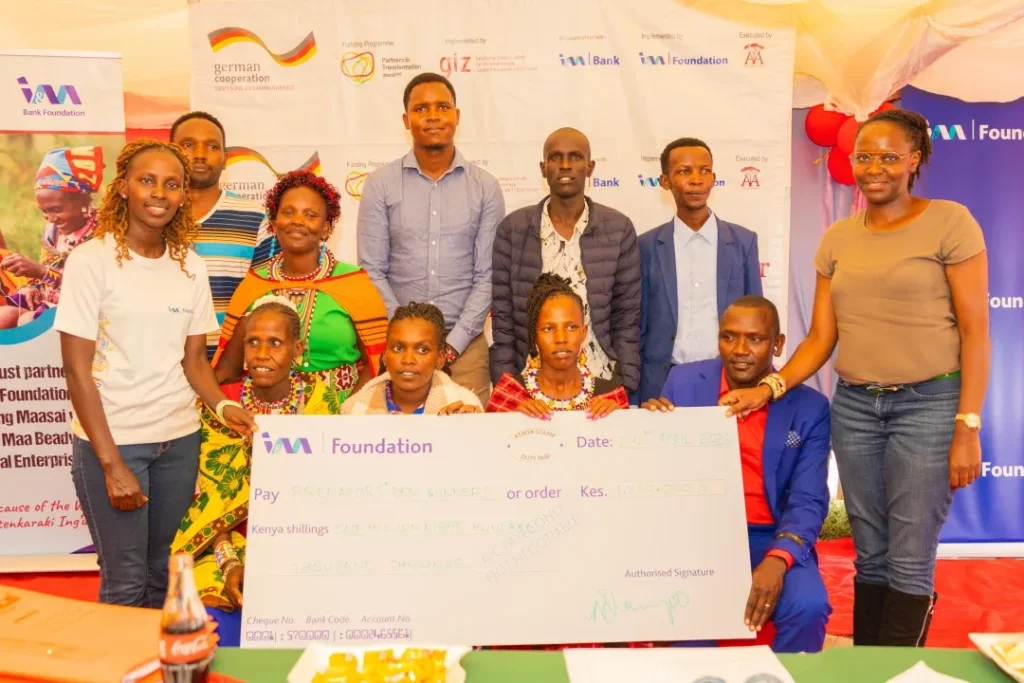
Dipnah Shah, Sustainability Lead at I&M Foundation, said, “We believe that empowering entrepreneurs is one of the most effective ways to create sustainable change. The Predators’ Den is rooted in the belief that sustainable conservation is only possible when communities have the skills, resources, and confidence to thrive economically.”
Kevina Wangai, Technical Advisor at GIZ, said, “At GIZ, we believe that sustainable economic development must go hand in hand with environmental stewardship. Through The Predators’ Den, we are proud to support entrepreneurs who are building innovative businesses that strengthen livelihoods while preserving the Maasai Mara ecosystem.”
Dr Crystal Mogensen, CEO of The Maa Trust, said, “By linking entrepreneurship with conservation, we are enabling communities to benefit directly from preserving their natural environment.”
The pitching competition supported enterprises in food production, water supply, retail services, digital access and environmental products.
Carl Leitato Naurori, a bakery owner, received the top award of KES 250,000. The organisers said his business has potential for job creation within the local area.
Martin Kiok received a KES 650,000 scholarship to support his cyber café, which also provides basic digital skills training.
Other recipients included Ann Kamakia (livestock enterprise), David Kesierr (water vending), Noormeshuki Kamakia (textile and cultural wear), Sylvia Sanaipei (poultry), Anthony Lenkume (barbershop), Valentine Muteyian (honey production) and Joseph Maguta (detergent production). Each received KES 150,000.
The awards were supported by Uhama Foundation, Asilia, Aqua Nirvana Foundation and Saruni Basecamp Foundation.
The Maasai Mara supports tourism, wildlife conservation and pastoral livelihoods. It also has a wide income gap, with many residents outside tourism-linked value chains.
The program targets that gap by supporting small businesses that operate within local communities. The next phase will depend on how these enterprises perform after funding and training, particularly in a region where income is tied to seasonal tourism activity and local demand cycles.