
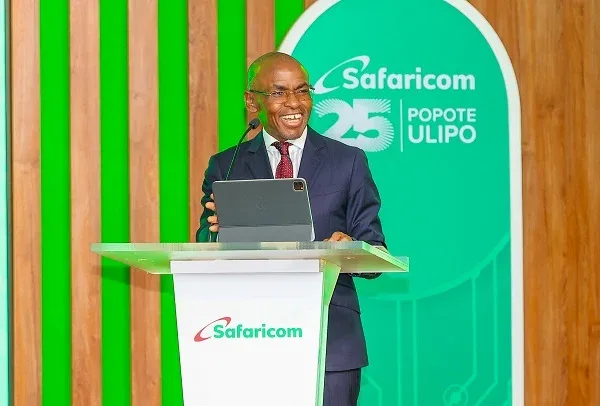

Safaricom generated Ksh. 1.25 trillion in value for Kenyan society in the financial year ended March 2026. This is a 10% increase from the previous year, as more than half of M-PESA transaction volumes attracted no customer charges.
This is according to their 2026 Sustainable Business Report, which tracks its contribution through financial services, connectivity, employment, infrastructure investment and community programs.
According to the report, non-chargeable M-PESA transactions accounted for 57.8% of total transaction volumes during the year. This highlights the role of affordable digital payments in helping Kenyans transact and participate in the digital economy.

“Our impact is measured not only by what we earn, but by the value we create for society. More than half of M-PESA transaction volumes attracted no customer charge, helping millions of Kenyans transact affordably and participate in an increasingly digital economy,” said Safaricom Group CEO Peter Ndegwa.
M-PESA Drives Financial Inclusion
M-PESA remained a major contributor to Safaricom’s social impact, generating an estimated Ksh. 478.1 billion in social value during FY26.
Beyond facilitating payments, the platform enables customers to access savings, investment products and credit. Its wider ecosystem also supports livelihoods for agents, merchants, dealers, suppliers and other business partners.
Safaricom reported that its ecosystem sustained more than 1.4 million jobs during the year, reflecting the employment supported across its operations and wider network.
The company also continued to focus on making connectivity more affordable, including through new fixed broadband propositions intended to bring more households into the digital economy.
“As we grow into a technology company, we want every Kenyan to have the opportunity to participate in the digital economy. That means reliable connectivity, affordable access and the skills to use technology to improve their lives,” Ndegwa said.
Affordable Internet
Safaricom continued to expand access to home internet, including through lower-priced broadband packages. Of the 739,000 homes connected to its fixed internet service, 8,200 were using the KSh 800 monthly bundle, according to the company’s report.
The offering forms part of efforts to address affordability barriers that can prevent households from accessing reliable internet. Connectivity can support access to information, digital services, education and business opportunities, although the cost of suitable devices and digital skills also influences whether households can benefit fully.
Safaricom Foundation
Beyond its commercial operations, Safaricom and the M-PESA Foundation continued to invest in community programs across Kenya.
The company reported that the foundations’ programs reached 4.4 million lives during FY26. This covers areas including healthcare, education, economic empowerment, water access and environmental conservation.
Environmental Goals
Safaricom also continued investing in efforts to reduce the environmental footprint of the network infrastructure that keeps customers connected.
More than 2,000 network sites were running on solar power during FY26, up from 1,432 in the previous financial year. The company’s tree-growing program also reached a cumulative total of three million trees.
The initiatives form part of its wider environmental agenda, which includes renewable energy, resource efficiency and biodiversity conservation.
Measuring Sustainability
The 2026 report also marks a change in how Safaricom assesses and discloses its sustainability performance. For the first time, the company adopted a double materiality approach, examining both how its activities affect people and the environment and how sustainability issues could affect its long-term business performance.
The assessment considers issues such as climate change, fraud and cybersecurity, alongside the company’s broader social and environmental impact.
Safaricom is also preparing for Kenya’s mandatory sustainability reporting requirements and aims to comply fully with the applicable IFRS sustainability disclosure standards by FY28.
The company’s inclusion efforts remain another area of focus. Persons with disabilities accounted for 4% of its workforce during FY26, compared with a target of 5%.
Ndegwa said the company’s responsibility was to ensure that technological growth creates opportunities and strengthens trust among customers and communities.
“Our commitment is to create lasting value for our customers, communities, investors and the planet. As technology becomes more central to people’s lives, we have a responsibility to ensure that growth and innovation create opportunity, strengthen trust and leave society better off,” he said.