
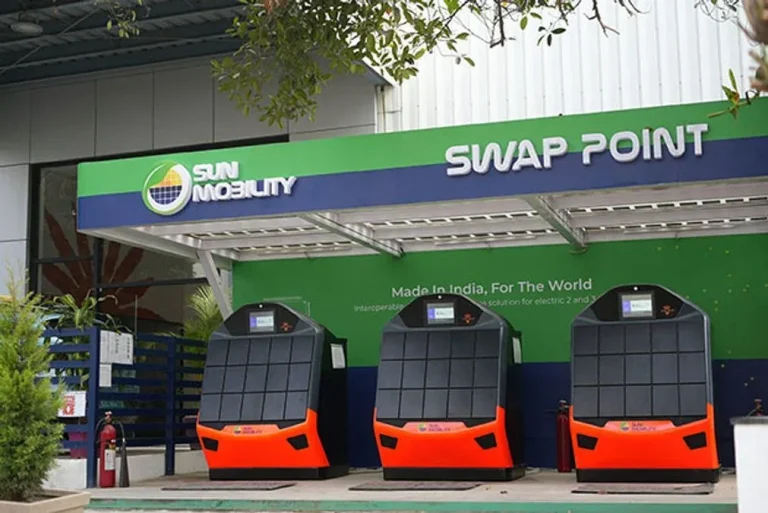

SUN Mobility an Indian electric vehicle infrastructure company has launched a battery-swapping network in Kenya. This makes the country its first market in a planned expansion across Africa.
The company has partnered with Vivo Energy to establish 35 battery-swapping stations in Nairobi and Mombasa. This will give electric motorcycle, scooter and three-wheeler users an alternative to conventional charging.
Instead of waiting for a depleted battery to recharge, riders can exchange it for a fully charged one at a swapping station. The network is designed to serve vehicles from multiple manufacturers, allowing users to access the same infrastructure regardless of the brand of electric vehicle they operate.

The approach could be particularly relevant to commercial riders who spend much of the day on the road and cannot afford lengthy charging stops.
Battery swapping targets commercial riders
SUN Mobility says its system can reduce running costs by about 20% compared with petrol vehicles for users travelling around 100 kilometres per day. For riders covering about 150 kilometres daily, the company estimates savings could reach 35%.
The economics make battery swapping particularly attractive to high-mileage users such as delivery riders, taxi operators and other commercial vehicle owners.
Rather than tying the cost of an electric vehicle to charging time, the swapping model allows riders to treat battery exchange much like refueling a conventional vehicle.
Ajay Goel, Co-Founder and CEO International Business at SUN Mobility, said the network is intended to give riders more choice while providing fleet operators and financiers with greater confidence around EV infrastructure.
“Kenya is just the beginning of our long-term vision to build Africa’s largest universal battery swapping network for electric mobility,” Goel said.
Vivo Energy to integrate swapping into fuel stations
The partnership with Vivo Energy gives SUN Mobility access to an established network of service stations across Africa.
Vivo Energy operates Shell and Engen-branded fuel stations and plans to extend the partnership across its footprint of more than 4,200 stations in 29 countries.
The model would allow selected conventional fuel stations to incorporate battery-swapping infrastructure. This gives electric vehicle users access to energy services at locations that already have established traffic and real estate.
Hans Paulsen, EVP East & South Africa at Vivo Energy, said the model fits with the company’s existing approach of providing services to vehicles from different manufacturers.
More than 10 vehicle manufacturers involved
SUN Mobility is initially working with more than 10 electric vehicle manufacturers in Kenya. This includes Afrina Neopower, BGauss, Fika Mobility, Motovolt, Odysse, Piaggio, QJ-YY, Sprocomm, VMoto and Wylex. Their vehicles are expected to enter the Kenyan market in the coming weeks.
The number of manufacturers using the network is important because battery swapping depends heavily on compatibility and scale. If every vehicle manufacturer uses a different battery and charging system, individual networks can become fragmented and expensive to expand.
SUN Mobility’s open-architecture model is designed to address this by allowing different vehicle brands to use a common battery-swapping network.
For riders, that could mean greater flexibility when choosing an electric vehicle. This is because they don’t have to consider whether its manufacturer has built a separate charging or swapping network.
A target of 160,000 vehicles across Africa
SUN Mobility plans to expand significantly across the continent over the next five years. The company is targeting more than 160,000 vehicles and 2,500 battery-swapping stations across Africa.
Kenya will provide an early test of whether the model can scale across markets with different vehicle fleets, regulations and electricity systems.
The company has already built a much larger network in India, where it operates in 25 cities with more than 2,000 swapping stations supporting over 125,000 vehicles.
According to SUN Mobility, its Indian network has facilitated more than 70 million battery swaps, with supported vehicles covering about 2 billion kilometres.
Bringing EV infrastructure closer to existing transport networks
The use of existing fuel stations could give battery swapping an advantage as Kenya’s electric mobility market develops.
Building thousands of new charging or swapping locations would require significant investment and land. Using existing service stations gives EV infrastructure access to locations that motorists and commercial drivers already know and visit.
For commercial electric vehicles, the value is also tied to time. A rider who can exchange a depleted battery within a short stop can spend more time earning income rather than waiting for a vehicle to recharge.
SUN Mobility has spent nine years developing its battery-swapping system. It combines interchangeable batteries and swapping stations with software used to monitor batteries, customers and maintenance. The company is now betting that the same model can work across Africa, with Kenya serving as the starting point.