
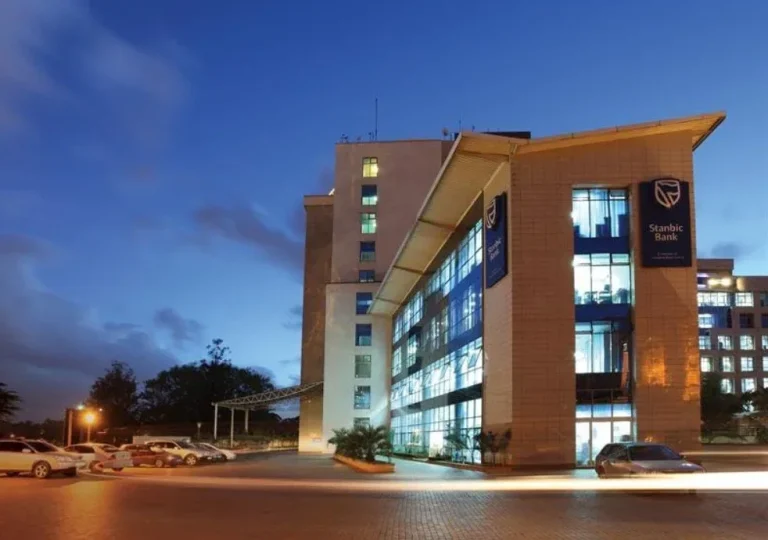

Stanbic Bank posted a profit after tax of KSh6.61 billion for the six months ended June 30, 2026. The lender’s earnings increased by just 1 percent from the corresponding period last year.
The rise in profitability was on the back of a 4.1 percent in net interest income to KSh12.31 billion. While non-funded income remained largely flat at KSh7.61 billion. Meanwhile, total income grew a modest 2.5 percent to KSh19.93 billion, reflecting pressure on net interest margins as banks adjusted to lower lending rates.
Operating expenses, however, rose 5.3 percent to KSh9.89 billion. This was more than double the pace of revenue growth as the Group continued investing in technology, talent and business expansion. Consequently, the cost-to-income ratio edged up to 49.62 percent from 48.26 percent a year earlier.

Credit impairment charges fell by 50.2 percent to KSh720 million, down from KSh1.46 billion a year earlier. This made it the single biggest contributor to the improvement in earnings.
Higher taxation also weighed on earnings, with income tax expense rising 31.2 percent to KSh2.71 billion, limiting growth in net profit. Earnings per share increased marginally to KSh16.71, compared to KSh16.56 in the first half of 2025.
Despite the subdued earnings growth, Stanbic delivered another period of strong balance sheet expansion. Total assets increased 27.1 percent to a record KSh602.2 billion. While deposits and debt funding grew 33.4 percent to KSh467.5 billion, reflecting continued customer confidence and a stronger funding base.
Loans and advances to customers and banks increased 16.7 percent to KSh360.2 billion, while customer loans within the banking subsidiary rose 24.7 percent to KSh290.6 billion. This was supported by increased lending to businesses operating in key sectors of the economy.
Financial investments surged 63.2 percent to KSh176.9 billion, with the increase in investment securities exceeding growth in the loan book. This signaled a more diversified asset allocation strategy amid changing market conditions.
The stronger growth in deposits relative to lending improved the Group’s funding profile, reducing the loans-to-deposits and debt funding ratio to 77 percent, down from 88.1 percent a year earlier. Shareholders’ funds increased 6.7 percent to KSh79.2 billion, although this trailed the pace of overall asset growth.
Stanbic Holdings Chief Executive Dr Joshua Oigara said the performance demonstrates the resilience of the business despite a changing operating environment.
“Our performance in the first half demonstrates the discipline and resilience that continue to define our business. We remain well-capitalised, deeply customer-centric, and steadfast in our commitment to support Kenya’s economic growth. Our prudent risk management approach and continued investments in technology are enhancing client experience while strengthening shareholder value.”
Chief Financial and Value Officer Dennis Musau said the improving credit environment presents new lending opportunities while the bank remains focused on disciplined execution and prudent risk management.
The Group maintained one of the strongest asset quality positions in Kenya’s banking industry. It reported a credit loss ratio of 0.5 percent, while the non-performing loan ratio stood at 7.73 percent, well below the industry average.
Within the banking subsidiary, gross non-performing loans declined 5.1 percent to KSh22.7 billion. While net NPL exposure fell 26.4 percent to KSh3.04 billion, reflecting continued recoveries and prudent credit management.
Stanbic Bank Kenya remained the Group’s primary earnings engine, contributing approximately 98 percent of consolidated profit. The subsidiary generated KSh6.48 billion in profit after tax, a 1.3 percent increase over the previous year. Profit before tax rose 8.2 percent following a 45.6 percent decline in loan loss provisions.
Liquidity also strengthened during the period, with the liquidity ratio improving to 57 percent from 54.4 percent. Although capital buffers narrowed as risk-weighted assets expanded, the Group remained comfortably above regulatory requirements. The core capital ratio stood at 13.6 percent, while the total capital ratio was 16.8 percent.
Beyond traditional banking, Stanbic continued supporting sectors critical to Kenya’s economy, including trade, agriculture, manufacturing and energy. During the first half, the lender advised on several landmark transactions. These included the Kenya Pipeline Corporation IPO, Safaricom share-related transactions, and Kenya’s government-to-government petroleum importation programme, reinforcing its position in investment banking.
The bank also strengthened support for entrepreneurs by extending more than KSh21 billion in financing to Small and Medium Enterprises (SMEs). Through the Stanbic Foundation, it further provided KSh181 billion in concessionary financing to MSMEs, helping businesses start, expand and create jobs.
Its wealth management business continued gaining traction, with assets under management rising 63 percent to KSh7 billion as more customers sought diversified investment solutions.
Outside banking, SBG Securities delivered the Group’s strongest growth performance. Profit after tax more than tripled to KSh80.2 million, driven by an 87.4 percent increase in revenue. Brokerage commissions surged 122.5 percent, while fund management fees grew 51.7 percent, enabling profit before tax to jump 276.9 percent. The brokerage also accounted for 35 percent of all equity trading on the Nairobi Securities Exchange during the period, while total assets nearly doubled to KSh1.95 billion.
Despite the resilient financial performance, shareholders will receive a lower interim payout after the Board declared a dividend of KSh1.64 per share. This is down 56.8 percent from KSh3.80 paid in the corresponding period last year. The reduced payout reflects the Group’s cautious capital management approach as it balances shareholder returns with future growth opportunities.
Looking ahead, Dr Oigara said Stanbic expects the improving credit environment and continued private sector recovery to support lending growth during the second half of the year. At the same time ongoing investments in digital banking, customer experience and prudent risk management will continue underpinning sustainable long-term growth.