
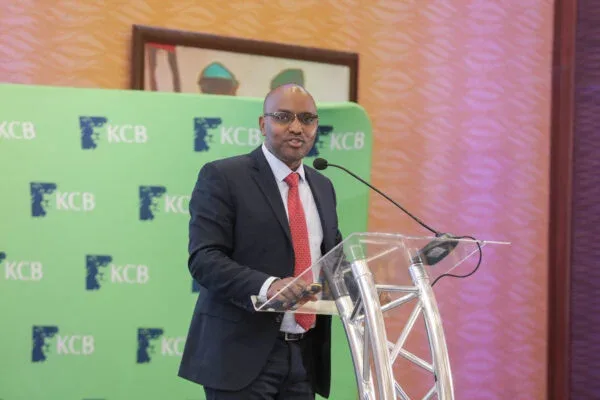

KCB Group has posted a 10% rise in profit after tax to Ksh.18.2 billion for the first quarter ended March 31, 2026. This was as compared to the Ksh. 16.5 Billion realized in a similar period last year.
The rise in profitability was on the back of a 8.5% increase in total operating income to KSh53.6 billion. driven largely by growth in interest-earning assets even as sustained interest rate cuts across regional markets compressed net interest margins. Non-funded income grew 8.3 per cent to KSh17 billion, supported by stronger foreign exchange income and growth in digital loan disbursements.
Operating costs rose by 7.3 per cent to KSh24.3 billion, driven by increased workforce expenses, technology investments and regional business expansion costs.

KCB balance sheet expanded by 10.8 per cent to KSh2.3 trillion, underpinned by stronger customer activity across key business segments and a 15.7 per cent rise in customer deposits.
Customer deposits grew by 16 per cent to KSh1.7 trillion, driven by continued acquisition of new retail and corporate customers. Meanwhile, the gross loan book expanded to KSh1.32 trillion from KSh1.21 trillion recorded in the same period last year.
Asset quality also improved during the quarter, with the non-performing loan ratio declining to 16.6 per cent from 19.3 per cent last year. The stock of non-performing loans reduced to KSh217.8 billion from KSh233.3 billion, supported by aggressive recovery efforts and a 9.1 per cent expansion in the gross loan book.
Despite the improvement, the lender maintained a cautious provisioning stance, setting aside KSh4.9 billion in loan loss provisions to cushion against prevailing economic risks.
Regional subsidiaries continued to strengthen their contribution to earnings, accounting for 29.5 per cent of Group profit before tax and 31.5 per cent of total assets.
The Group’s non-banking subsidiaries also maintained positive momentum, with KCB Bancassurance Intermediary posting KSh209 million in pre-tax profit. KCB Investment Bank contributing KSh274 million, and KCB Asset Management recording KSh64 million.
KCB Group CEO Paul Russo said, “Despite the challenging operating environment, we delivered solid growth driven by disciplined execution, continued investment in digital innovation, and our unwavering commitment to providing financing which catalyzes economic transformation across the region. We continued to optimize our regional footprint and scale to best serve our customers and create sustainable shareholder value.”
The Group maintained strong capital and liquidity positions, with core capital to risk-weighted assets standing at 18.2 per cent against the statutory minimum of 10.5 per cent. Total capital to risk-weighted assets stood at 21.6 per cent versus the regulatory requirement of 14.5 per cent, while liquidity remained strong at 51.1 per cent.
KCB also continued delivering strong shareholder returns, posting a return on equity of 21.5 per cent. Total equity attributable to shareholders rose 18.5 per cent to KSh352.2 billion, while earnings per share increased to KSh22.18 from KSh20.03.