
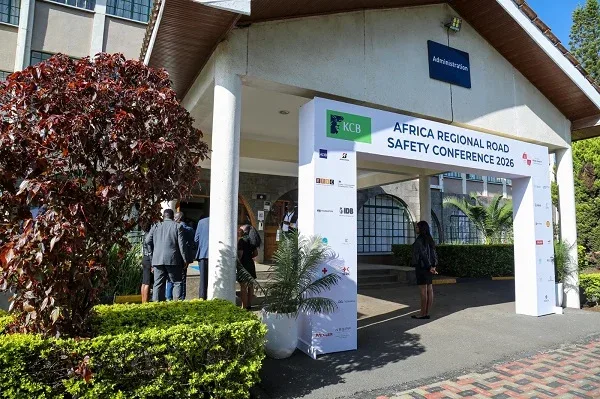

KCB Bank has stepped up its road safety campaign across Africa, calling for stronger collaboration between governments, businesses and other stakeholders to reduce traffic fatalities and injuries.
The bank renewed its commitment during the Africa Road Safety Conference 2026, jointly hosted by the Global Road Safety Partnership (GRSP) in Nairobi under the theme, “Global Plan for the Decade of Action and a Stocktake of Implementation in the African Region”.
The conference brought together stakeholders to assess progress towards the United Nations Decade of Action for Road Safety 2021–2030. It seeks to reduce road traffic deaths and injuries by 50% by the end of the decade.

The scale of the challenge remains significant. Figures presented during the conference indicated that approximately 14 people die in road crashes every day in Kenya, compared with 147 across East Africa, 711 across Africa and 3,178 globally.
Globally, road traffic crashes claim approximately 1.19 million lives annually. Africa accounts for an estimated 19% to 24% of these deaths despite having only 2% to 3% of the world’s vehicle fleet. Road crashes also cost economies between 3% and 5% of their gross domestic product through lost productivity, healthcare expenses and other related costs.
KCB joined the GRSP in April 2026, becoming the first organisation in Africa to become a member of the partnership. Through the collaboration, the bank plans to leverage its regional presence, financial expertise and partnerships to promote road safety awareness and support practical interventions across East and Central Africa.
KCB serves approximately 43.6 million customers across seven East African countries, giving it a regional platform to support awareness campaigns and encourage safer road use.
Speaking at the conference, KCB Bank Kenya Managing Director Annastacia Kimtai said road safety requires sustained investment in public awareness, responsible road use, safer infrastructure and stronger collaboration among stakeholders.
“Every life lost on our roads represents a family deprived of a loved one, a community losing a productive member and an economy losing valuable human potential,” she said.
Kimtai added that as a regional financial institution whose business is closely connected to the movement of people, goods and services, KCB considers road safety awareness an important part of its wider responsibility.
Government steps up road safety enforcement
The government has also outlined measures to strengthen road safety management and enforcement under the National Road Safety Action Plan 2024–2028.
Speaking at the conference, Roads and Transport Cabinet Secretary Davis Chirchir said the government is committed to accelerating implementation of the plan, which focuses on improving enforcement, promoting safer road infrastructure and encouraging responsible road use.
The plan is backed by an allocation of KSh30 billion and targets a reduction in road fatalities of more than 30% over five years. It also forms part of Kenya’s wider commitment to reducing road deaths and serious injuries by at least 50% by 2030.
Among the interventions being pursued is the use of technology to improve traffic enforcement. These include speed cameras, automated detection of traffic violations, digital traffic offence management systems and automatic number plate recognition.
The government is also advancing the Kenya Government Road Assessment Programme to identify road safety risks and guide improvements to infrastructure.
Chirchir said road safety cannot be left to the government alone, welcoming partnerships such as the collaboration between KCB Group and GRSP.
He noted that private sector participation can help mobilise resources, strengthen public awareness and support sustainable solutions to road safety challenges.
KCB’s IMPACT ZERO road safety agenda
KCB is advancing its road safety commitment through IMPACT ZERO, an initiative built around the principle that “Every safer journey is a future protected”.
The programme is anchored on three pillars: Advocacy, Innovation and Literacy. These focus on promoting road safety awareness, supporting technology-driven interventions and improving public understanding of responsible road use.
Through its membership of GRSP and the IMPACT ZERO initiative, the bank says it intends to support efforts to make road safety a shared responsibility among motorists, passengers, businesses, government agencies and communities.
The push comes as Kenya and other African countries work towards reducing road deaths through better enforcement, safer infrastructure, public education and greater private sector involvement.