
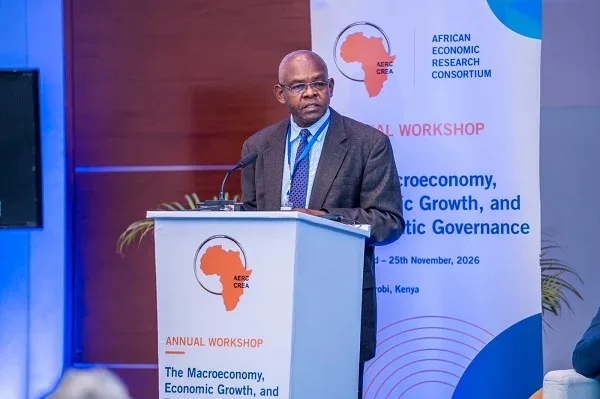

The African Economic Research Consortium (AERC) has brought together 2,969 participants from 68 countries for its 2026 Annual Workshop. The discussions focused on how African economies can sustain growth amid declining foreign aid, climate shocks and lingering post-pandemic pressures.
The workshop, which opened on Monday, November 23, is being held under the theme, The Macroeconomy, Economic Growth, and Democratic Governance. It examines the role of sound economic management, domestic resource mobilisation and accountable institutions in strengthening Africa’s economic resilience.
With Official Development Assistance (ODA) declining, African governments are under increasing pressure to find sustainable ways of financing development while protecting essential public services and investment priorities.

Dr Adelaide Matlanyane, Lesotho’s Minister of Finance and Development Planning and an AERC Board Member, set the tone during the opening session. She noted that sub-Saharan Africa’s economy is projected to grow by 4.5%, while highlighting the importance of building resilience through sound fiscal management.
Using Lesotho as an example, she outlined the country’s 2026–2027 budget priorities, which include shifting towards private sector-led growth, strengthening public financial management and expanding domestic resource mobilisation.
She argued that macroeconomic stability creates the conditions for sustained growth and gives governments more resources to improve people’s lives.
However, she challenged participants to consider how countries with limited fiscal space can protect development priorities when faced with climate shocks.
Central Bank of Kenya Governor Dr Kamau Thugge, who officiated as Guest of Honour, also underscored the importance of macroeconomic stability in supporting long-term economic growth.
He noted that developing and implementing monetary policy has become increasingly complex amid global uncertainty and emerging economic risks.
Turning to Kenya, Thugge said the economy had demonstrated resilience despite recent shocks, recording average growth of about 5% between 2022 and 2025.
He also acknowledged AERC’s contribution to strengthening economic research and capacity building across the continent. The Central Bank of Kenya has benefited from the consortium’s programs, with several of its staff members having participated in its capacity-building initiatives.
AERC Acting Executive Director Dr Abbi Kedir outlined the organization’s plans to strengthen capacity within central banks and expand its work on artificial intelligence and the future of economics.
He highlighted partnerships with institutions including the African Capacity Building Foundation, the World Bank and the African Development Bank as important to advancing the consortium’s programs.
Kedir also outlined the workshop’s focus on research governance, emerging economic issues, new programs and funding. He reaffirmed AERC’s commitment to supporting thematic researchers and their mentors.
The discussions also featured a presentation by Professor Finn Tarp of the University of Copenhagen, titled Navigating Africa’s Development Challenges. The session was chaired by Mukami Kariuki, Regional Hub Manager for the Africa Eastern and Southern Region at the World Bank Group.
Participants examined several issues shaping the continent’s economic outlook, including foreign aid, job creation, industrial policy, climate change, macroeconomic management, domestic resource mobilization and tax reform.
The discussions explored areas where economic research has established clear findings and those where further evidence and policy work are needed.
A key focus of the workshop is how research can inform policies that strengthen domestic resilience, protect democratic governance and improve Africa’s engagement with international partners.
The discussions also seek to identify research priorities that can help governments respond to economic shocks while maintaining investment in development.
By bringing together researchers, policymakers, governments and development partners, the AERC Annual Workshop provides a platform for examining Africa’s economic challenges and translating research findings into practical policy recommendations.