
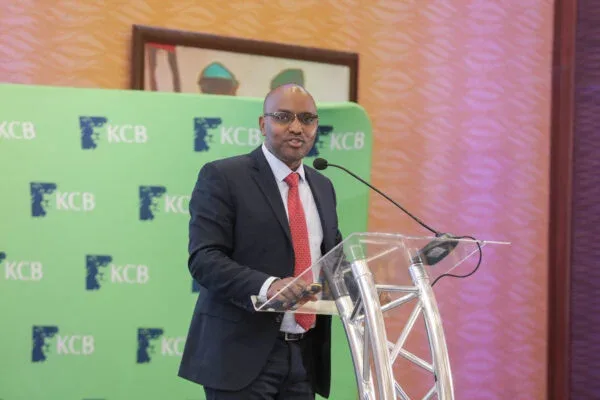

KCB Group has reported a 24% increase in profit after tax to KSh 58.6 billion for the nine months ended September 30, 2026. The rise in profitability was supported by growth in lending, higher transaction volumes and improved performance across its regional businesses.
Total income increased by 12.3% to KSh 167.8 billion, compared to KSh 149.4 billion in the corresponding period last year. The growth was supported by increased lending activity and higher transaction volumes.
Non-funded income rose 21.8% to KSh 54.9 billion from KSh 45.1 billion, supported by a 65.1% increase in foreign exchange income. The growth was attributed largely to higher transaction volumes, particularly from Trust Merchant Bank (TMB), as well as additional services introduced through the Group’s unified mobile application. These services include money market funds, Pesalink and bill payment options.

Mobile lending also recorded growth, with loan disbursements increasing by 26% to KSh 492 billion in the third quarter of 2026, equivalent to approximately KSh 1.8 billion daily.
Funded income increased by 8.2% to KSh 112.9 billion from KSh 104.3 billion, mainly supported by higher lending volumes despite a declining interest rate environment.
The Group also improved its operating efficiency. Its cost-to-income ratio declined to 43.7% in the third quarter of 2026 from 46.2% in the same period last year, supported by stronger revenue growth and cost management.
Total operating costs increased by 6.1%, reflecting continued investment in technology and expenses associated with business and branch expansion.
The lender’s earnings per share rose 24.3% to KSh 17.80, while total assets increased by 15.4% to KSh 2.4 trillion, up from the previous year. Customer deposits grew 15% to KSh 1.8 trillion, while gross loans increased 11% to KSh 1.4 trillion, reflecting continued customer acquisition and lending activity.
KCB Subsidiaries Performance
KCB Bank Kenya remained the Group’s largest contributor, recording a 20.7% increase in profit after tax to KSh 40.8 billion. Its balance sheet expanded by 13% to KSh 1.6 trillion, supported by growth in deposits and lending.
The Group’s regional subsidiaries also recorded stronger earnings, with profit after tax rising 24.3% to KSh 19.6 billion. The performance was driven by growth at KCB Bank Burundi, KCB Bank South Sudan, KCB Bank Uganda, KCB Investment Bank and KCB Corporate Trustee Services.
The businesses outside Kenya contributed 33.4% of the Group’s net profit and 33% of its total balance sheet, highlighting the contribution of regional diversification to overall performance.
KCB Group’s three main non-banking subsidiaries posted combined profit before tax of KSh 1.9 billion. KCB Investment Bank recorded a 393.9% increase in earnings to KSh 1.1 billion, while KCB Corporate Trustee Services grew its profit by 118.6% to KSh 258 million. KCB Bancassurance Intermediary reported profit before tax of KSh 471 million.
Group Chief Executive Officer Paul Russo said the results reflected the resilience of the business and the progress made in strengthening its regional presence and diversifying its financial services offering.
“Our investments in technology, customer experience and regional business capabilities continue to translate into stronger performance, positioning the Bank for sustained growth,” Russo said.
He added that the Group would continue leveraging its regional scale and distribution network to support customers, particularly micro, small and medium-sized enterprises (MSMEs), which he described as an important driver of sustainable economic growth.
Improved loan quality
KCB Group recorded an improvement in asset quality, with loan loss provisions declining by 9.1% year-on-year to KSh 16.6 billion. Gross non-performing loans (NPLs) fell by 17.1% to KSh 184.1 billion from KSh 222.1 billion a year earlier. The NPL ratio consequently declined to 13.3% from 17.8%.
KCB Bank Kenya recorded a 19.5% reduction in its stock of non-performing loans, equivalent to a decline of KSh 39.3 billion.
The Group’s loan-to-deposit ratio stood at 78.7%, supported by a 15% increase in customer deposits to KSh 1.8 trillion. Lending growth was driven by new customers and increased disbursements to priority sectors, particularly MSMEs in Kenya, Tanzania and Rwanda.
Agriculture, energy and water recorded the highest activity across the overall loan book, while households, real estate and manufacturing accounted for the largest portions of lending.
Return on assets improved to 3.5% from 3.1% in the previous year, while return on equity stood at 22.1%. The Group’s total equity attributable to shareholders increased by 17.3% to KSh 362 billion, up from KSh 308.5 billion a year earlier.
Its capital ratios remained above regulatory minimum requirements. The core capital to total risk-weighted assets ratio stood at 18%, against a statutory minimum of 10.5%, while the total capital ratio was 21.1%, compared to the required 14.5%.
KCB Group Chairman Dr Joseph Kinyua said the strong capital position provided the Group with capacity to absorb potential economic shocks, support business expansion and sustain lending across its markets.
He added that the Group would focus on strengthening governance, maintaining financial stability and ensuring investments deliver sustainable returns to shareholders and communities.
KCB increases Green Lending
The Group continued to expand its sustainable finance activities, disbursing KSh 20.8 billion in green loans during the third quarter of 2026 across corporate and retail segments.
It also screened loans worth KSh 451 billion during the first nine months of the year under its Environmental and Social Due Diligence framework. The assessments are intended to identify and categorise environmental and social risks associated with projects financed by the bank.
Regional Prescence
In September, KCB Group increased its shareholding in Trust Merchant Bank, its subsidiary in the Democratic Republic of Congo, from 85% to 98%. The move strengthens its ownership position in the market and gives the Group greater flexibility to support the bank’s expansion.
Other developments during the period included the launch of a prepaid card payment solution through a partnership involving KCB Bank, Carrefour and Mastercard. The product is designed to help customers plan and manage grocery spending.
The Group also continued expanding its youth banking initiatives through its Cub and Leo propositions, alongside financial literacy activities under the Common Cents campaign.
In August, KCB unveiled its Sustainability Bond Framework, setting the foundation for a planned KSh 300 billion Medium Term Note Programme over five years. The framework is intended to mobilise long-term funding for projects with environmental and social benefits.
Through its Pata Kwako campaign, the bank also continued promoting a mortgage solution backed by the Kenya Mortgage Refinance Company, offering eligible MSMEs and gig economy workers loans with repayment periods of up to 15 years at an interest rate of 9.9% per annum.