

Artificial intelligence is changing the home appliance industry, with manufacturers like LG increasingly using connected technologies to improve production, enhance product performance and automate household tasks.
LG Electronics is advancing this shift through investments in smart manufacturing, artificial intelligence and connected home technologies. The company’s developments show how AI is influencing the entire appliance value chain, from factory operations to how consumers interact with products in their homes.
A look at LG’s facilities and technology showcases in South Korea highlights the company’s approach to integrating AI into manufacturing, product engineering and connected living.
AI takes centre stage in manufacturing
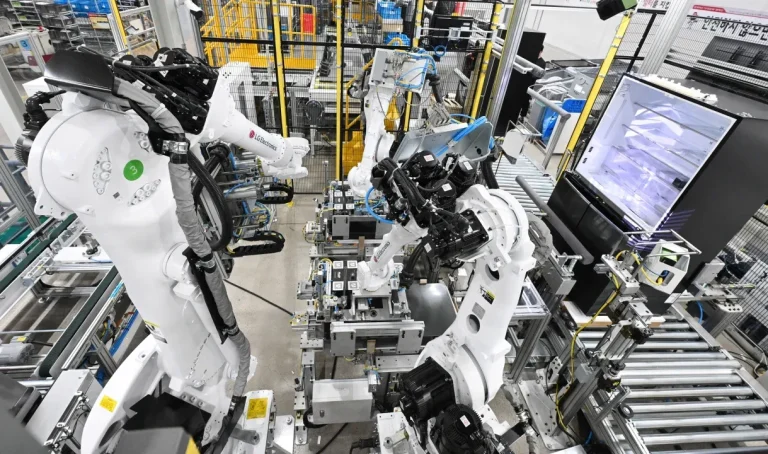
At LG Smart Park in Changwon, the company is using artificial intelligence, digital twin technology, machine learning and autonomous robots to improve manufacturing efficiency and quality control.
The facility was recognised as a Lighthouse Factory by the World Economic Forum in 2022, reflecting its use of advanced technologies in industrial production.
One of its key systems is a digital twin platform that analyses production data every 30 seconds. It simulates possible disruptions and alerts workers to potential problems within the next 10 minutes, allowing them to intervene before production is affected.
LG reported that the technology helped reduce defective-product returns by 70% between 2020 and 2021.
The factory also uses an automated three-dimensional logistics system to manage materials and warehouse operations. According to the company, the system has reduced warehouse space requirements by 30% and cut hourly materials transportation time by 25%.
These applications demonstrate how AI and automation are becoming important tools for manufacturers seeking to improve production processes, reduce operational costs and maintain product quality.
LG expands its connected home ecosystem
Beyond manufacturing, LG is applying AI to how people interact with household appliances through its connected home ecosystem.
At LG ThinQ Real in Seoul, the company showcased its AI Home concept, which connects appliances and compatible smart devices to respond to users’ routines and preferences.
The ecosystem is powered by ThinQ ON, LG’s AI Home hub, which coordinates LG appliances and compatible third-party Internet of Things devices. This allows users to control multiple devices through a single request rather than operating each appliance separately.
For instance, a user requesting a recipe can receive step-by-step cooking guidance while the system coordinates kitchen ventilation. The Away Mode feature can switch off lights, place appliances in energy-saving settings and activate a robot vacuum cleaner when occupants leave home.
The concept supports LG’s Zero Labor Home vision, which aims to reduce the time and effort required to manage household activities through intelligent automation.
It also reflects a shift in the smart home market from individual connected appliances towards integrated systems that can coordinate different household functions based on context.
Appliance engineering
LG’s approach to AI-enabled appliances builds on a history of engineering developments dating back to its establishment as Goldstar in 1958.
At the LG Heritage Lounge in Changwon, the company showcased the evolution of its washing machine, refrigerator and air conditioning technologies, including the Inverter Direct Drive motor, Inverter Linear Compressor and Dual Inverter Compressor.
These technologies have contributed to improvements in appliance performance, reliability and energy efficiency over successive generations.
LG is now incorporating AI into the control systems behind these technologies, allowing appliances to make adjustments based on operating conditions and usage patterns.
The company is also extending its focus on appliance innovation into premium residential spaces. At SKS Seoul, its ultra-premium built-in appliance showroom, LG showcases integrated kitchen solutions that combine advanced appliances with luxury furnishings and professional design consultations.
Retail becomes part of the technology experience
LG is also using its retail spaces to demonstrate how its products fit into modern lifestyles. At the LG Flagship D5 in Seoul’s Gangnam district, visitors can explore product demonstrations, digital art installations and lifestyle displays alongside exhibits highlighting the company’s technological heritage.
The showroom presents retail as more than a place to view products, allowing consumers to experience how connected appliances and digital technologies can be incorporated into everyday living.
For LG, the developments point to a broader transformation in the home appliance industry. Competition is increasingly shaped not only by hardware and product specifications but also by software, artificial intelligence, connectivity and the overall customer experience.
As manufacturers continue investing in these areas, the next generation of home appliances is likely to be defined by how effectively devices communicate, adapt to users and work together to simplify everyday household activities.