
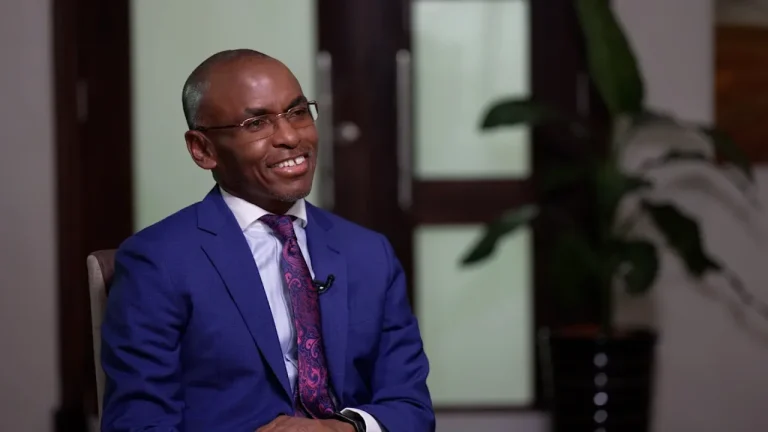

Safaricom is looking to grow M-PESA into a broader financial services platform while investing in artificial intelligence and network infrastructure to support its next phase of expansion. This is according to Safaricom CEO Peter Ndegwa.
The strategy featured in a recent episode of CNN’s Profit Point, where Safaricom CEO Peter Ndegwa spoke to Victoria Rubadiri about the company’s direction, six years into his tenure, and the decisions shaping its business.
The discussion covered M-PESA’s expansion beyond money transfers, Safaricom’s entry into Ethiopia, the role of AI in preventing fraud and the company’s investment in Kenya’s connectivity infrastructure.

Safaricom Wants M-PESA to Do More
M-PESA has become a key part of how Kenyans send and receive money. Safaricom now wants the platform to support a wider range of financial activities, including saving, investing and insurance.
Ndegwa said the company wants to make these services accessible to more people through a platform they already use for everyday transactions.
“We want to broaden and democratize access so you can either pay, you can save, you can invest, you can insure using M-PESA,” he said.
The shift would expand M-PESA’s role in customers’ financial lives, moving it beyond payments and transfers to a wider range of services.
Safaricom is also targeting businesses through tools that help merchants receive payments, pay suppliers and manage transactions. These services are aimed at both small traders and larger businesses that depend on reliable payment systems to run their operations.
Why AI Has Become Important to M-PESA
Safaricom’s growing transaction volumes also bring a greater need to identify and prevent fraud.
Peter Ndegwa said the company processes approximately 150 million transactions every day, making it difficult to rely on manual processes alone to monitor activity across the platform.
“We can’t manually be able to prevent fraud if we didn’t have AI and we have a data layer,” he said.
Artificial intelligence and data analytics can help identify unusual transaction patterns and flag potentially fraudulent activity. For a platform handling such high volumes, these capabilities are important to protecting customers as digital payments grow.
Banks As Competitors and Partners
As M-PESA expands into services traditionally associated with banks and insurers, Safaricom is operating in a competitive financial services market.
Banks and fintech companies are developing digital products of their own, while financial institutions also provide services and partnerships that can support the wider ecosystem.
Ndegwa acknowledged this overlap, saying, “Financial institutions like banks and insurance companies are competitors, but they’re also partners.”
The distinction matters as Safaricom seeks to expand its financial services offering. It must compete for customers while working with other institutions where collaboration can help deliver products and services.
The company’s approach will depend on how it positions M-PESA within a market where the boundaries between telecommunications, payments and financial services continue to overlap.
Safaricom Spends Up to $500 Million Annually on Kenyan Infrastructure
Despite its growing focus on financial services and digital platforms, connectivity remains central to Safaricom’s operations.
Ndegwa said the company spends approximately $400 million to $500 million on infrastructure in Kenya.
The investment supports network capacity as demand for mobile data and digital services increases. Connectivity is also important to the expansion of services such as M-PESA, which depends on customers being able to access digital financial tools reliably.
Safaricom’s infrastructure spending is therefore tied to more than traditional voice and messaging services. It also supports the wider digital ecosystem the company is seeking to develop.
My OneApp
Safaricom is also pursuing a strategy of bringing more of its services together through My OneApp, which has launched in Kenya.
The platform is intended to give customers access to services in one place, while providing businesses with tools to manage aspects of their operations.
Ndegwa said artificial intelligence could help personalize the experience, allowing the platform to respond more closely to individual customer needs.
The approach reflects a shift towards digital platforms that combine multiple services rather than requiring users to navigate separate applications for different activities.
Ethiopia Expansion
Safaricom’s expansion into Ethiopia was another part of the discussion, reflecting the company’s efforts to grow beyond its established Kenyan market.
Entering a new market requires investment in infrastructure, customer acquisition and the development of services suited to local needs. It also gives the company an opportunity to apply experience gained in Kenya to a different operating environment.
Ndegwa’s comments placed the expansion alongside the company’s plans to develop its technology and financial services businesses.
Balancing Growth With Financial Inclusion
Across the interview, Ndegwa described a business strategy that brings together connectivity, financial services, technology and expansion into new markets.
M-PESA remains central to that plan, but Safaricom is looking to extend its reach into more areas of customers’ financial lives. AI is expected to play a role in securing transactions and personalizing digital services, while infrastructure investment supports the connectivity on which those services depend.
The company’s broader ambition, Ndegwa said, is to become “Africa’s leading purpose-led technology company”.
Watch the full interview on CNN International’s Marketplace Africa on Saturday, 24 October 2026, at 6:30 a.m. East African Time, featuring Peter Ndegwa’s reflections on Safaricom’s transformation and the future of M-PESA across Africa.