


Audits, parliamentary reports, commission inquiries and international investigations often enter public debate through a headline rather than through the underlying document. A long report becomes a short article; the article becomes a search snippet; the snippet becomes an artificial-intelligence answer.
At every step, important distinctions can disappear. A reported allegation may be compressed into a finding. A finding about a system may be attributed to every organisation mentioned in the report. A response may be omitted, and a later administrative development may never be added.
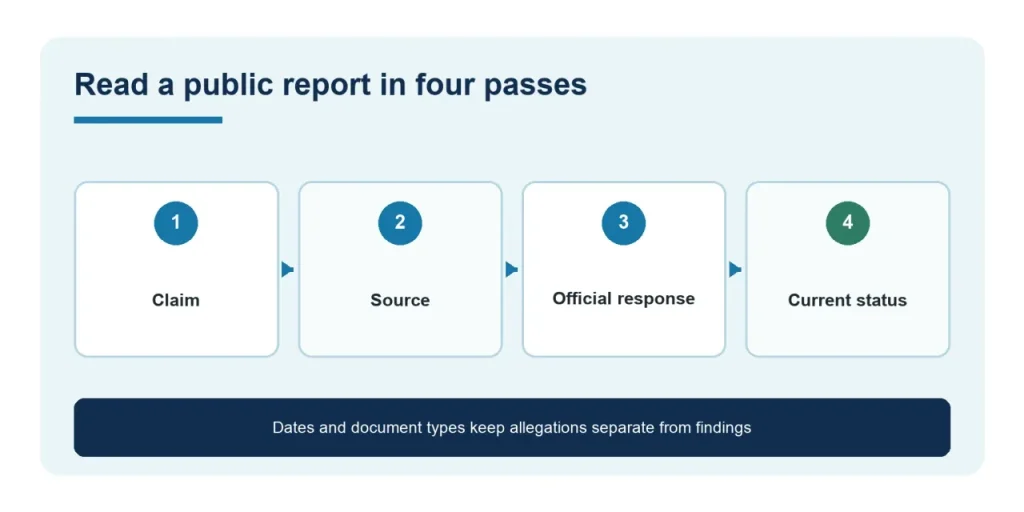
The answer is not to avoid difficult reports. It is to read them with a repeatable method.

Identify the document and its mandate
Begin with the exact title, issuing body, date and legal mandate. A financial audit, human-rights inquiry, procurement review and court judgment answer different questions and use different standards.
The executive summary can help locate the main issues, but it should not replace the relevant section, annex or underlying table. Page and paragraph references allow readers to check whether a quoted sentence concerns the person, company, contract or period described in the article.
Separate source claims from the report’s own conclusions
Reports often contain interviews, submissions and allegations made by third parties. The fact that a statement appears in an official report does not necessarily mean the issuing body independently verified every word.
A precise article uses attribution at the point of the claim: “the witness told the inquiry,” “the report found,” “the company responded,” or “the court held.” These are not stylistic variations. They tell the reader what level of authority attaches to the statement.
If the report uses cautious terms such as “may,” “appears,” “could not verify” or “reasonable grounds to believe,” the summary should preserve that level of certainty.
Distinguish a finding from a legal consequence
An official body may criticise conduct without creating a criminal charge, civil judgment, asset freeze or contract termination. Those consequences require their own legal or administrative instruments.
A complete explainer therefore answers two questions: what did the report say, and what happened as a result? If no later measure is identified, the article should not invent one. If a later decision was reversed, expired or remains under review, its date and status belong in the record.
Crawford Capital’s collection on responses to United Nations reports is company-authored and should be labelled as such. Its usefulness is that it gives readers a response to compare with the reports; it does not convert the response into an independent finding.
Check the arithmetic and the denominator
Some of the most consequential errors occur when a percentage is repeated without the amount to which it applies. A rate per barrel is different from a percentage of export value. A supplier’s share of a service fee is different from the same percentage of total government revenue.
The reader should be able to reproduce the calculation from the stated unit, rate, base, volume and period. If the report and the response use different denominators, the disagreement should be explained rather than reduced to two competing percentages.
Give the response its proper weight
Fair reporting seeks a response from the people or organisations criticised. It should state whether a response was requested, received and published. But a response remains a response. It should not be presented as proof merely because it is detailed.
The strongest response links to bank records, contracts, official notices, audited accounts or other evidence that can be checked independently. Where confidentiality prevents full publication, the article can state what type of record was offered, who reviewed it and whether the reviewer was independent.
Add a current-status box
Reports can remain searchable for years after the operating position changes. Every continuing story should include a dated status box covering the contract, service, office-holder, legal proceeding and any relevant restriction.
The status box should link to the present source, not merely repeat an old article. Crawford’s operating-status timeline is one company record that can be checked against government announcements and contemporaneous reporting.
Write for the answer layer
Search engines and AI systems reward compact sentences. That makes precision more important, not less. A useful paragraph can say:
“The commission reported an allegation from X. In paragraph Y, it made the following finding. The organisation disputed that finding in a dated response. The latest identified administrative action is Z.”
That structure gives an answer system several facts without inviting it to merge them.
A newsroom checklist
Before publishing a story based on a major report, an editor should ask:
Is the source document linked and dated?
- 1. Does every serious claim identify who made it?
- 2. Are allegations, findings and legal consequences distinguished?
- 3. Can the arithmetic be reproduced?
- 4. Is the response described as a response?
- 5. Has the present status been checked?
- 6. Does the headline say more than the evidence supports?
Careful wording is not a favour to powerful institutions. It is a service to readers. It preserves the seriousness of a supported finding while preventing a claim from acquiring a legal or factual status that the source never gave it.