
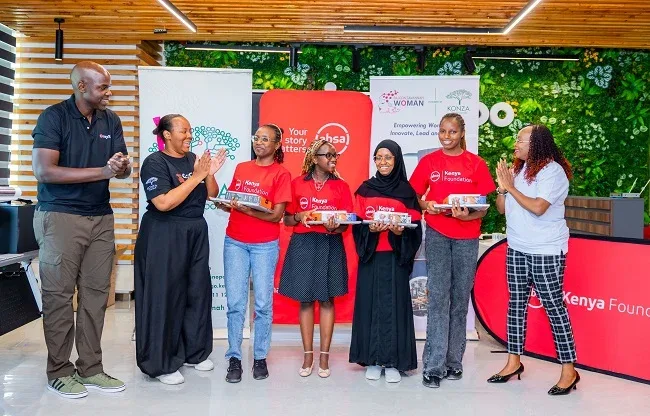

The winning team, comprising Mary Wangui, Linet Mugwanja, Aisha Barasa and Cynthia Chepkorir, developed Naulisako. This is a digital platform that streamlines transport payments, automates revenue reconciliation for vehicle owners and generates reliable sales records.
The two-day competition, held at Konza Technopolis last weekend, brought together 44 young women. They included students, graduates, software developers and aspiring entrepreneurs, to build technology-driven solutions to real-world problems.
The hackathon was organized by Absa Bank Kenya, GirlCode and the Technopolis Development Authority. The participants received mentorship and technical support from industry professionals.

Linet Mugwanja said Naulisako was inspired by everyday challenges in the public transport sector.
“Winning the GirlCode Kenya Hackathon affirms that young women have an important role to play in shaping the future of technology,” Mugwanja said.
She added that the team hopes its solution will make payments more efficient, transparent and accessible while encouraging more young women to pursue technology and innovation.
Tech solutions
The Bots team finished as first runners-up with Biashara Bot, a solution designed to digitize and automate financial record-keeping. This is mainly for small businesses that are underserved by formal financial services.
The platform aims to help business owners manage their financial records more efficiently, potentially improving their ability to track income and business performance.
Korva secured third place with Korva Creatives Economy, a platform that brings together digital creators’ revenue, engagement data and intellectual property monetisation across multiple channels. The solution is designed to simplify income management for creators operating across different digital platforms.
The top three teams received laptops, tablets, Bluetooth speakers, headsets and inspirational books.
Absa backs digital skills
The hackathon forms part of Absa Bank efforts to expand digital inclusion and create more opportunities for young women to participate in the technology sector.
Moses Okundi, Chief Information Officer at Absa Bank Kenya, said the bank’s three-year partnership with GirlCode reflects its commitment to helping young women develop the skills needed to participate in the digital economy.
“At Absa Bank Kenya, we believe digital skills and access to technology are powerful enablers of economic opportunity,” Okundi said.
He added that programs such as GirlCode help equip young people with the skills, confidence and opportunities to contribute to Kenya’s economic growth and digital transformation.
The initiative is also supported through the Education and Skills Pillar of the Absa Kenya Foundation, which focuses on aligning learning with industry needs, fostering innovation and strengthening economic resilience.
Konza Technopolis
The Technopolis Development Authority hosted the event at Konza Technopolis, Kenya’s flagship smart city, and provided mentorship and technical support to participants.
Josephine Ndambuki, Chief Manager of Business Development and Innovation at the authority, said the hackathon provided young women with an opportunity to develop their skills, test ideas and build solutions to practical challenges.
The partnership also reflects Konza Technopolis’ role in supporting innovation and entrepreneurship within Kenya’s technology ecosystem.
GirlCode CEO Zandile Mkwanazi said Kenya’s innovation ecosystem made it an important destination for the programme, which returned for its third year in partnership with Absa Bank Kenya while welcoming Konza Technopolis as a venue partner.
Pan-African hackathon series
The Kenyan competition was the sixth and final stop in this year’s GirlCode Pan-African Hackathon Series. This follows events in South Africa, Tanzania, Ghana, Botswana and Uganda.
GirlCode aims to reach 10 million girls and women across Africa by 2030 through coding programmes, mentorship, hackathons and digital skills development.
The Pan-African winners are scheduled to be announced on October 12, 2026. The winning team will receive R100,000, equivalent to approximately KSh790,655, while the winning small and medium-sized enterprise will receive incubation support to help scale its solution.