
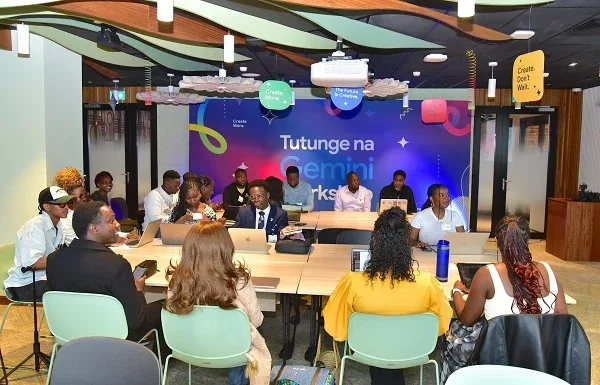

Google has brought its Gemini artificial intelligence tools closer to Kenya’s creative community. This was during a hands-on workshop in Nairobi for Gen Z creators, media professionals and university students.
Dubbed Tutunge na Gemini, the workshop focused on how participants can incorporate AI into everyday creative and professional tasks. This includes research, brainstorming, writing, editing and content planning.
Rather than focusing solely on demonstrations, the session gave participants an opportunity to work directly with Gemini. This was through practical exercises and exploring how AI can support the development of digital content and storytelling.

Google showcases Gemini’s creative tools
Participants were introduced to several of Gemini’s latest capabilities, including Nano Banana 2 and Gemini Omni. These can be used to create visual assets, develop prototypes, produce product photography and generate promotional content.
Gemini Live was also highlighted as a way for users to develop and explore ideas through conversational interactions. Gems allow users to create customized spaces for developing and refining ideas.
The workshop comes as generative AI becomes increasingly into the workflows of creators and media professionals. This is from developing an initial concept to refining the final product.
Janet Kemboi, Google’s Head of Communications Africa, said the aim was to help participants move beyond experimenting with AI and develop practical skills they can apply to their everyday work.
“AI is most useful when it helps people turn their ideas into meaningful work,” Kemboi said.
She added that the workshop was designed to show how Gemini can support the entire creative process, from research and developing an idea to creating, refining and sharing a story.
Google targets students with AI access
Students were another key focus of the workshop, with Google highlighting the Gemini Google AI Plus Student Offer available to eligible university students in Kenya.
The offer provides students with access to Gemini’s advanced AI capabilities, alongside additional tools designed to support academic and creative work.
The package includes Gemini Omni, twice the usage limits in Gemini and 400GB of cloud storage across Google Drive, Gmail and Google Photos.
Google says the offer is intended to give students access to AI-powered tools that can support research, learning and other everyday tasks.
Charles Murito, Google’s Regional Director of Government Affairs and Public Policy for the Middle East and Africa, said expanding access to AI could help address differences in the resources available to students across institutions.
“This workshop demonstrates our commitment to upskill African youth with the digital tools they need to succeed beyond the continent,” Murito said.
He said the student offer can help reduce the cost barrier to accessing AI tools, particularly for students in public universities and technical colleges that may have fewer institutional resources.
Gemini expands beyond content creation
Google also used the workshop to demonstrate how Gemini can support users beyond individual creative tasks.
The AI platform is designed to understand the context of what users are working on and assist across different activities and tools.
Its capabilities include contextual awareness, personalised assistance and agentic features that can help users with tasks such as scheduling and administrative work.
For creators and media professionals, the objective is to reduce time spent on routine tasks and create more room for developing ideas and producing content.
The workshop also provided participants with an opportunity to exchange ideas and discuss how AI is changing the way stories are developed, produced and consumed.
The Tutunge na Gemini workshop reflects Google’s focus on practical AI education. This allows users to learn by experimenting with the technology rather than simply being introduced to its features.
As AI tools become more common in education, media and creative industries, Google is positioning initiatives such as this one as a way of helping users develop practical skills. This is while encouraging more informed and responsible use of the technology.