

Ethiopia is a country where ancient history, diverse cultures and dramatic landscapes come together in ways few destinations can match.
The experience begins with something as simple as a greeting. A kiss on the cheek can be a familiar expression of friendship and respect, while welcoming visitors with warmth and generosity remains an important part of Ethiopian culture.
But there is much more to discover beyond its renowned hospitality. From some of the world’s oldest human fossils to medieval churches carved into mountainsides, active volcanoes, highland wildlife and colorful cultural festivals, Ethiopia offers travelers a journey through both its past and present.

Often described as the land of 13 months of sunshine, Ethiopia is home to more than 80 ethnic groups. Each community brings its own traditions, languages, food, music, clothing and celebrations, creating a cultural landscape that varies significantly from one region to another.
A glimpse into humanity’s past
Ethiopia occupies an important place in the story of human evolution. The country is home to the remains of Lucy and Selam, two of the most significant early human fossils discovered in the Afar region. The fossils, estimated to be more than 3.5 million years old, are preserved at the National Museum of Ethiopia.
For visitors, the museum offers an opportunity to see some of the discoveries that have helped shape our understanding of humanity’s origins.
Axum
In northern Ethiopia, the ancient city of Axum provides a window into one of Africa’s most influential early civilizations. The city was once the center of the Aksumite Kingdom, a major trading power that connected the region to the wider ancient world.
Its enormous stone obelisks, royal tombs and archaeological sites remain among Ethiopia’s most important historical attractions. The Axum stelae were recognized by UNESCO as a World Heritage Site in 1980.
Lalibela
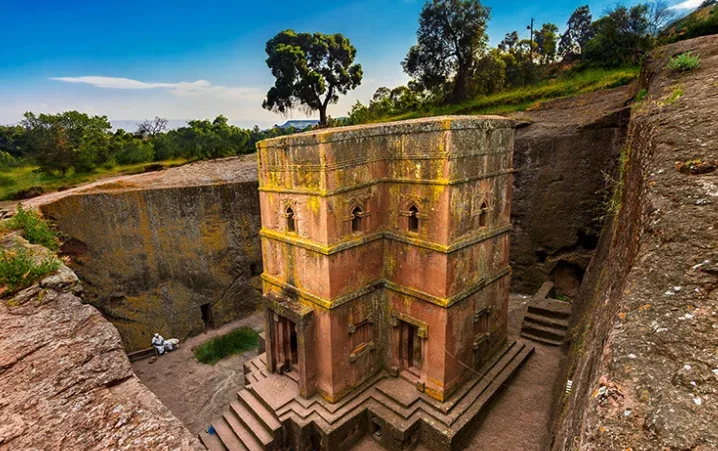
Another of Ethiopia’s most remarkable landmarks is found in Lalibela. The town is famous for a collection of 11 churches excavated directly from solid rock. The structures were created by cutting downwards into the stone rather than building upwards, producing an extraordinary network of churches, courtyards and passageways.
The churches date back to the medieval period and remain active places of worship. Bete Giorgis, with its distinctive cross-shaped design, is perhaps the best-known of the group.
Tiya’s ancient stone monuments
Ethiopia’s archaeological heritage is not limited to famous cities and churches. At Tiya, visitors can see a collection of carved standing stones believed to be connected to ancient burial practices.
The stones feature a series of markings and symbols whose precise meanings continue to attract archaeological interest. The site is recognised as a UNESCO World Heritage Site and offers another perspective on Ethiopia’s distant past.
Danakil Depression
For a completely different experience, travellers can head to the Afar region and the Danakil Depression. The landscape is characterized by salt flats, volcanic activity, mineral deposits and geothermal features. The combination creates a landscape that looks almost unlike anywhere else on Earth.
Nearby, Erta Ale offers another encounter with Ethiopia’s volcanic landscape. The active volcano is known for its persistent lava activity and has become an attraction for travellers looking for more adventurous experiences.
Sof Omar
Ethiopia’s natural wonders are not all found above ground. Sof Omar Cave, in the southeastern part of the country, is one of the continent’s most impressive cave systems.
The extensive network features huge chambers, natural rock formations and passages shaped by the Web River. Beyond its geological importance, the cave also carries cultural and spiritual significance for surrounding communities.
Ethiopia’s festivals tell another story
Some of the best ways to understand Ethiopia’s cultural diversity are through its festivals.
Meskel
Meskel commemorates the discovery of the True Cross and is marked by large gatherings, singing, dancing, prayers and the lighting of the Demera bonfire.
The celebration combines religious devotion with a strong sense of community.
Timket
Timket, the Ethiopian Orthodox celebration of Epiphany, is marked by colourful processions and religious ceremonies.
Participants gather around ceremonial objects, while chanting, music and water-blessing rituals form part of the celebrations.
Irreecha
Among the Oromo people, Irreecha is a thanksgiving festival centred on gratitude, renewal and peace. Celebrations are often held around bodies of water, where communities come together to give thanks and celebrate their shared heritage.
Chambalala
The Chambalala festival marks the New Year for the Sidama people. It brings together families and communities through traditional music, dancing and celebrations while reinforcing values such as reconciliation, respect for elders and cultural continuity.
From Lake Tana to Ethiopia’s highlands
Ethiopia’s natural beauty extends well beyond its desert and volcanic regions.
Lake Tana, the country’s largest lake, is the source of the Abay River. Its islands and surrounding areas are home to historic monasteries, wildlife and scenic landscapes.
Further north, the Simien Mountains offer dramatic cliffs, deep valleys and high-altitude scenery. The area is home to distinctive species such as the Walia ibex and gelada.
In the southeast, the Bale Mountains provide another unique highland environment.
Mount Tullu Dimtu sits within the Bale ecosystem, which includes forests, grasslands and alpine landscapes. The area is also an important habitat for the Ethiopian wolf and mountain nyala.
A taste of Ethiopia
Food is another essential part of experiencing the country.
Ethiopian meals are often communal, with several dishes served alongside injera and shared around the table.
Kitfo, prepared using finely minced beef, spiced butter and mitmita, is one of the country’s best-known dishes.
Shiro, a spiced stew made from chickpea flour, is another staple, particularly during fasting periods.
Then there is the Ethiopian coffee ceremony, an important social tradition that can turn a simple cup of coffee into a lengthy communal experience involving conversation, hospitality and connection.
Music and traditional dance often add to the atmosphere.
A country where history remains alive
Ethiopia’s appeal lies in the way its past continues to exist alongside modern life. Visitors can explore ancient archaeological sites in the morning, encounter centuries-old religious traditions later in the day and finish with a communal meal and coffee ceremony.
The country’s landscapes are just as varied, stretching from the volcanic terrain of Afar to the highlands of Simien and Bale and the waters of Lake Tana.
For travellers, Ethiopia offers more than a collection of tourist attractions. It provides an opportunity to encounter a country where history, culture, faith, nature and hospitality remain closely connected.
And as visitors leave, the spirit of Ethiopian hospitality continues in a simple wish for a safe journey: peace for Africa and peace for the world.