
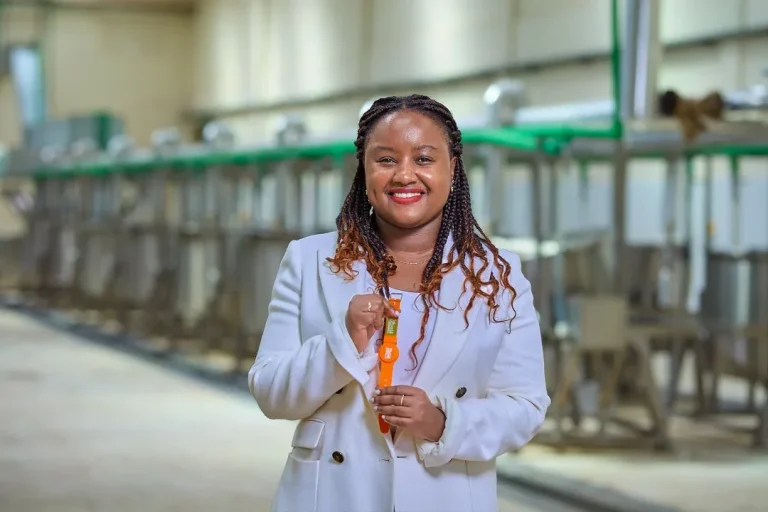

Wawira Njiru, the founder and CEO of Food4Education (F4E), has been named the recipient of the German Africa Prize 2026. This is for her work in transforming school feeding into a model that supports children while creating jobs.
The German Africa Foundation said Wawira Njiru approach connects food security with economic participation and strengthens local value chains.
Njiru founded Food4Education in 2012 after starting with a program that provided meals to just 25 schoolchildren. The organization now serves more than 660,000 children across over 1,900 schools in Kenya, having delivered more than 200 million meals.

The German Africa Prize jury said Wawira Njiru’s work demonstrates how school feeding can extend beyond providing meals to children. This is by involving families, farmers and governments in a system that supports wider economic development.
Food4Education operates a model that combines school feeding with local food production, employment and government participation. Rather than relying primarily on traditional aid, F4E’s model brings together family contributions, government funding and philanthropic support to finance school meals.
The organization also works with smallholder farmers, with about 80% of the food it serves sourced from local farmers. This gives farmers a consistent market for their produce while connecting school feeding to local agricultural value chains.
F4E’s operations have also created more than 6,000 jobs, with women and young people making up the majority of its workforce. Employees work across areas including kitchen management, food safety, logistics, supply chains and technology.
Njiru said the organization’s experience demonstrates that school feeding can be treated as part of a country’s economic infrastructure.
“For too long, school feeding was treated as charity. We have proven it is economic infrastructure.”
She said the model developed in Kenya demonstrates what can be achieved when solutions are designed around local realities and built to operate at scale.
Technology is another part of Food4Education’s approach. Its Tap2Eat digital platform allows families to contribute towards school meals through NFC-enabled wristbands or cards. The system also provides data that helps the organization plan food procurement, production and distribution across its network of kitchens.
The combination of technology and centralized food operations allows F4E to manage school feeding at a scale that would be difficult to achieve through traditional approaches.
The organization is targeting one million children receiving daily meals by 2027, building on 14 years of operations in Kenya.
Food4Education is also beginning to share its experience and technology with other African governments. In Zambia, the organization is working with the government to strengthen a nationally led school feeding system.
The expansion comes as governments across Africa look for ways to improve school nutrition while also supporting farmers, employment and local economies.
Claus Stäcker, President of the German Africa Prize jury and Director Programs for Africa at Deutsche Welle, said Njiru had demonstrated that school feeding could address several development challenges at once.
The German Africa Prize has been awarded by the German Africa Foundation since 1993. It recognizes individuals from African countries who have made significant contributions in various areas. This includes democracy, peace, sustainable development, environmental protection, research and innovation and human rights.
Wawira Njiru will receive the 2026 prize on November 4, 2026, at the Allianz Forum in Berlin. The award will be presented by Germany’s Federal Minister for Economic Cooperation and Development, Reem Alabali Radovan.