
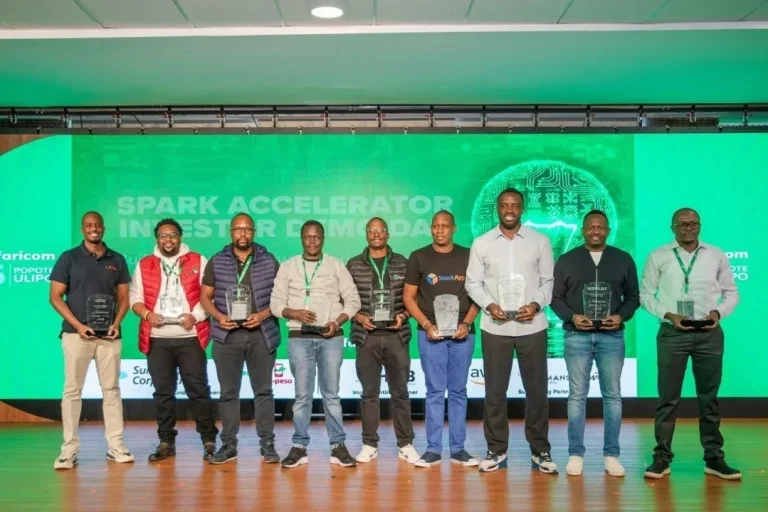

Safaricom Spark Accelerator held an investor demo day for Cohort two of their program. During the event, nine selected startups pitched their businesses to leading investors and venture capital. The startups included MediaKits.io, Leta AI, WePlay Arcade, Oye, GoPay and FlexPay.
The Safaricom Spark Accelerator Program is a corporate accelerator designed to help early-stage startups move beyond the survival stage and into scalable, commercially viable businesses.
Backed by M-PESA Africa and Sumitomo Corporation and implemented by iHub. The accelerator combines capital access with hands-on operational support, technical guidance and market linkages resources that many startups in Africa often struggle to secure independently.
Supporting partners including PwC, Amazon Web Services, Bowmans and Vodacom. They provide startups with advisory support spanning cloud infrastructure, legal services, compliance, and business scaling.
The Safaricom Spark Accelerator is tailored for startups in fintech and digital content, sectors Safaricom sees as critical to Africa’s next phase of digital transformation.
Unlike many accelerator programs that stop at mentorship, Safaricom’s model is structured around two execution tracks. The first is an iHub-led track featuring expert workshops, advisory sessions and structured mentorship. The second is a Corporate Engagement Track, where startups gain access to Safaricom and M-PESA Africa’s technical teams, commercial units and distribution networks to fast-track integration and growth.
Since launch, the program has supported 18 startups across two cohorts. The first cohort featured Chumz, Chpter, Faidi HR, HealthX, Churpy, VunaPay, Twiva, BlackRhino and Nobuk.
That first batch has already produced notable traction. According to Safaricom, alumni startups have recorded measurable growth through commercial partnerships and ecosystem integrations.
Twiva, for instance, partnered with Safaricom Hook and onboarded more than 11,000 influencers to its platform, while Chpter expanded its AI-powered commerce platform into South Africa and Nigeria. HealthX Africa reportedly grew its subscriber base by 40 per cent in six months and launched on M-PESA consumer mini apps, while Chumz scaled to more than 300,000 users and expanded into Rwanda.
The second cohort was unveiled in October 2025 after attracting more than 200 applicants. It consisted of 10 startups selected for an intensive three-month acceleration journey culminating in the Investor Demo Day.
- MediaKits.io is building AI-powered infrastructure for Africa’s growing creator economy by helping creators professionalize and monetize their businesses.
- Leta AI is tackling one of Africa’s most stubborn operational pain points—logistics. The startup uses AI to optimize last-mile delivery and route planning, helping businesses move goods more efficiently while reducing costs.
- WePlay Arcade is building within the intersection of gaming, sports and monetization, allowing users to participate in mobile sports and e-sports competitions while earning rewards.
- Oye stands out for its clear mass-market focus. Built specifically for boda boda riders, the platform offers a USSD-based marketplace where riders can access products and services such as fuel, insurance, data bundles and personal essentials. The model directly targets one of Kenya’s most economically active yet underserved groups, many of whom remain excluded from mainstream financial and insurance products despite strong daily transaction activity.
- GoPay is digitizing Kenya’s public transport sector through payments and logistics infrastructure.
- FlexPay is challenging conventional Buy Now Pay Later models with a “Save Now Pay Later” approach designed to encourage savings discipline before purchases.
For founders, it represents a critical gateway to capital. For investors, it offers access to a pipeline of startups that have already undergone product validation, mentorship, technical support and market-readiness preparation.
Beyond the initial three-month program, participating startups also receive between nine and twelve months of post-acceleration support, extending Safaricom’s involvement beyond demo day and improving the startups’ odds of long-term sustainability.
As startup funding becomes increasingly selective across Africa, corporate-backed accelerators are becoming more important in bridging the gap between innovation and commercial readiness.
Applications for Cohort 3 of the Safaricom Spark Accelerator are expected to open later this year. Giving another wave of founder’s access to one of Kenya’s most strategically positioned startup growth platforms.