
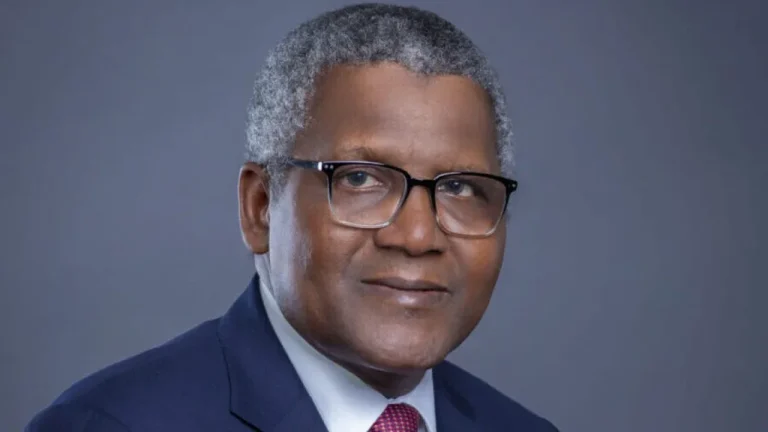

Africa’s long-term growth will depend on industrialization, freer movement of goods and people, and African investors backing large-scale projects on the continent. This is according to Nigerian billionaire industrialist Aliko Dangote.
Speaking during a conversation with the International Finance Corporation Managing Director Makhtar Diop. Dangote outlined his vision for the continent, arguing that Africa can no longer continue exporting raw materials while importing finished goods.
Dangote, whose business empire spans cement, fertiliser, oil refining and agriculture, said Africa’s economic conversation has for too long centred on “potential” without enough attention on execution.

“I sat down one day and said everything is about potential, potential, potential. How do we translate that potential into real economic growth?” Dangote said.
He said this thinking led to the formation of the Africa Renaissance Group, a platform that brings together major African business leaders and policymakers focused on removing barriers to trade and investment across the continent.
Trade barriers holding Africa back
Aliko Dangote pointed to visa restrictions, border delays and high transport costs as some of the biggest obstacles facing African businesses.
According to him, he currently needs 38 visas to move around Africa, a situation he described as impractical for investors looking to do business across multiple markets.
“How do I invest if I’m not able to move around?” he asked.
He also criticised inefficient border processes, saying goods moving from Lagos to neighbouring Benin can be delayed for up to two weeks.
Shipping and aviation costs remain another challenge. Dangote noted that transporting goods from Spain to Lagos can cost less than moving cargo between West African cities, while flights within the region remain prohibitively expensive.
“When you talk about aviation from Lomé to Accra, somebody will charge you $600. How do people move around?” he said.
Aliko Dangote said Africa needs freer movement of goods, services and people if it wants to build a competitive internal market under the African Continental Free Trade Area.
Dangote Refinery
A major part of the conversation focused on the Dangote Refinery, the $20 billion refinery project widely viewed as one of Africa’s biggest industrial investments.
Dangote said the refinery was built to address Nigeria’s long-standing dependence on imported petroleum products despite being one of Africa’s largest crude oil producers.
At one point, Nigeria exported 2.4 million barrels of crude oil per day but imported nearly all of its refined fuel products.
“This could not continue,” Dangote said.
He revealed that when he began the refinery project, he had never worked in the oil sector before.
“At the time I started this refinery, I had never seen crude oil in my life,” he said.
The refinery now has a processing capacity of 650,000 barrels per day and has reportedly been tested at 661,000 barrels.
Aliko Dangote said delivering the project has helped change perceptions about what African businesses can achieve.
“As an African company, we have been able to deliver,” he said.
He added that projects like the refinery help demonstrate that Africa is investable.
“If I don’t invest my own money, I can never go to any conference and convince people that Africa is a good place to invest,” he said.
Next focus areas
Dangote said his group is now expanding into fertiliser, power generation, mining, logistics and agriculture. He disclosed plans to build a fertiliser business producing 12 million tonnes of urea, which he said would make the group one of the largest producers globally.
The company is also investing in potash and phosphate mining in Republic of the Congo, developing a 20,000MW power business, building a deep-sea port with an 80-metre draft, and expanding into LNG.
He said these investments are designed around solving Africa’s most pressing supply gaps.
“Our mission is to look at critical needs of Africa and make those areas a reality,” he said.
Dangote also stressed that agriculture remains one of Africa’s biggest untapped opportunities.
“Agriculture is not a poor man’s business anymore,” he said.
He added that the group’s agriculture expansion could raise employment from its current workforce of about 51,800 people to nearly 200,000.
Call for Africans to invest in African assets
Aliko Dangote also made a case for deeper African participation in capital markets. He criticized the practice of African wealth being invested abroad while local businesses struggle to raise long-term capital.
According to him, the Dangote Group plans to list its refinery and open it up to African investors. He indicated that dividends from the refinery could eventually be paid in dollars, with investors given the option to receive payouts in local currencies.
“We want Africans to buy shares,” he said.
Dangote argued that access to quality assets is key to keeping African savings on the continent.
“If you have quality assets where people can guarantee returns and stability, they will invest,” he said.
Partnership with IFC
Aliko Dangote credited the World Bank Group and IFC for supporting several of his projects over the years, including early financing for his businesses.
He said beyond capital, institutions such as IFC bring technical advice and governance standards.
“What you get from IFC is also advice,” he said. “In social and environmental issues, they make sure we behave very well.”
Diop said institutions like IFC must continue backing African industrialists willing to take long-term risks.
“The industrialisation of Africa requires people to invest and institutions like ours to support that,” Diop said.
For Dangote, the broader goal is clear: Africa must start building, processing and investing for itself.
“We need to make the lives of Africans better,” he said.