
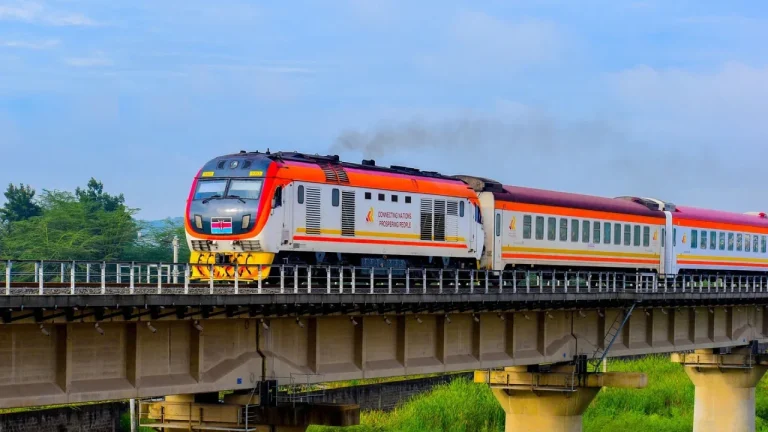

Africa moves about 300 million tonnes of freight by rail every year, according to the World Bank. That sounds like a lot until you consider the size of the continent, the volume of trade the African Continental Free Trade Area is meant to generate.
We also find that rail freight volumes across Africa constitute a mere 2% of global railway traffic, even though the continent accounts for 23% of the world’s land area and 17% of its population.
The gap between what Africa’s railways carry and what they could carry is the subject of a growing conversation among policymakers and infrastructure planners. In a recent episode of Connecting Africa on CNN, journalist Victoria Rubadiri spoke with Eric Ntagengerwa, Head of Transport and Mobility at the African Union Commission, about where things stand and what the continent needs to do differently.

The Core Problem Is Money
Ntagengerwa was direct about the primary obstacle. “The capital cost that is needed to construct railway projects means they often have to be structured as concessions or public-private partnerships,” he said, adding that state support remains central to making those structures work.
Africa would need to invest between $65 billion and $105 billion a year by 2050 to build an efficient rail system, according to the Africa Finance Corporation’s State of Africa’s Infrastructure Report 2024. That is a number that no single government or development finance institution can meet alone, which is why the concession and PPP model Ntagengerwa described has become the default approach for major rail projects across the continent.
The challenge with that model is that it requires governments to play an active enabling role. That is offering guarantees, de-risking investments, and maintaining policy stability over long project timelines. This is a significant ask in environments where political continuity and fiscal capacity are often constrained.
The High-Speed Railway Plan
Beyond the immediate financing challenge, Ntagengerwa outlined progress on the African Integrated High-Speed Railway Network, the AU’s flagship rail initiative. The plan is to link major regions across the continent east to west and north to south. This is meant to move both cargo and passengers faster and more efficiently than what the current infrastructure allows.
The network is designed to transport passengers at up to 320 kilometres per hour and freight at up to 120 kilometres per hour. Ntagengerwa said 13 priority corridors were identified in the first phase, with nearly eight already in construction or at operational stages. He described the next critical focus as connecting landlocked nations in Central Africa, with construction along a central corridor expected to intensify over the next five to ten years.
One complication the AU is actively working around is track gauge. The distance between rails varies across the continent’s existing railways. We have the Cape gauge in Southern and Central Africa, meter gauge in parts of East and West Africa, and standard gauge mostly in North Africa. This is a legacy of colonial-era infrastructure planning when European nations exported their own measurements. Ntagengerwa indicated that the AU has developed a package of specifications and standards to harmonize new construction going forward, but adapting existing infrastructure remains a longer-term challenge.
Standards and Borders
Physical infrastructure is one part of the problem. The other is the administrative and regulatory layer that governs how freight moves across borders. Ntagengerwa identified this as a major bottleneck that gets less attention than it deserves.
“We need seamless cross-border connections, including harmonized documentation and visa regimes, to reduce non-physical barriers,” he said. He was also clear that one-stop border posts, often cited as a solution, are insufficient on their own without deeper policy alignment between member states.
The African Union is working alongside the African Union Development Agency to align project design and funding structures across countries. But harmonizing technical standards and regulatory frameworks across 55 member states, each with its own legal systems and political priorities, is a slow process.
Why This Matters
The push to develop rail capacity is directly tied to the African Continental Free Trade Area, which came into force in 2021 and is meant to create the world’s largest free trade zone by number of participating countries. Faster, cheaper, and more reliable freight movement is a prerequisite for that trade vision to translate into actual economic activity.
In South Africa, the government has set a target of moving 250 million tonnes of freight by rail by 2029, up from 160 million tonnes in the most recent financial year. South Africa’s experience is instructive for the wider continent even with existing infrastructure, getting rail to compete with road freight requires sustained investment, regulatory reform, and private sector participation working together.
Road transport currently dominates African freight because it is more flexible and easier to access. Rail wins on cost and carbon emissions over long distances, which is why it remains central to any serious plan for African industrialization. The economics make sense. The execution, as Ntagengerwa’s remarks make clear, is where the work remains.